Tuesday, December 12, 2006

Blockbuster CEO Still Has 'Total Access' to Private Jets


On November 29, 2006, in-home movie rental and game entertainment provider Blockbuster (BBI-$$5.17) announced that in connection with the Company’s sale of its corporate aircraft, the Board had also entered into an addendum to its employment contract with Mr. John Antioco, its Chairman and Chief Executive Officer. Specifically, Mr. Antioco’s employment contract was modified by reference so that instead of use of the Blockbuster aircraft, he was entitled to continued use of a chartered aircraft.

According to the Company’s Proxy Statement filed with the SEC last April, during fiscal year 2005 and fiscal year 2004, Mr. Antioco (1) received a base salary of $1,250,000 and additional, deferred compensation of $383,333 and $1,045,192 in base salary and $1,000,000 in deferred compensation, respectively; (2) received a cash bonus of $5.0 million paid in 2004 (for 2003 performance); received 5.0 million restricted stock units worth $26.8 million in 2004; (3) received a car allowance of $1,100 per month for each year; and, (4) recorded expenses of $92,125 for personal use of the Company’s plane in each year.

Since early 2001, Blockbuster’s tickets to failure include an average net margin of (10.0)% per annum, more than $3.0 billion in net losses, and about a 70 percent decline in the market value of its common stock [$10K invested in Blockbuster’s stock five years ago would be worth approximately $3,100 today].

Continued declines in worldwide same-store sales, uncertainty in execution to an online subscriber business model (
Total Access), increased competition for traffic from other online channels of video distribution (Netflix), margin pressures on the sales of in-store videos from mass-merchandisers of lower-priced DVDs (such as Wal-Mart), and a leveraged balance sheet—Total Debt/Equity of 141.6 percent—which will curb marketing and limit business options (to simple decisions like closing under-performing stores)—Blockbuster has more to worry about than whether or not its CEO flies chartered or coach.

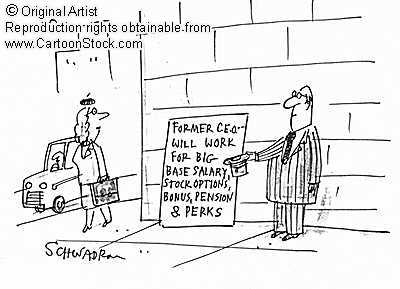
As for Mr. Antioco, in our view he is just another expression of a pampered CEO (he is still making gobs of money—albeit shareholders and the Company have made nothing). “Mr. Antioco, the peanuts they serve in coach taste just fine!”


Editor David J. Phillips holds no financial interest in any of the stocks mentioned in this article. The 10Q Detective has a full disclosure policy.

Friday, December 08, 2006

What’s Over-the-Horizon for Comtech Telecom?

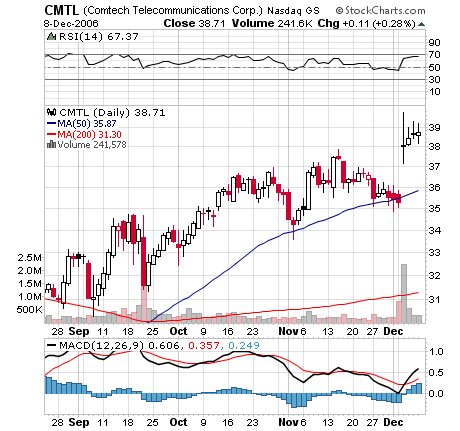
Sleepwalking through most of the spring, shares of Comtech Telecommunications (CMTL-$38.71) sprang awoke in June 2006, and have jumped about 50% in value after the telecom-equipment maker raised its guidance outlook (for FY 2006).

On Monday, management raised its guidance (again) for 2007 earnings to $2.05 to $2.07 per share, up from its previous view of $1.93 to $1.95 a share.

The Company said that it expects 2007 revenue of $440 million to $450 million, up from its previous outlook of $435 million to $445 million, citing demand for its Movement Tracking System (due to deliveries on actual and anticipated new orders from the U.S. Army and Army National Guard for ongoing support of MTS program activities).

According to Reuters estimates, analysts were expecting 2007 earnings of $1.80 a share, before special items, on revenue of $439.4 million.

Comtech said in its most recent fiscal quarter ended October 31, 2006, its 1Q:07 profit fell 6 percent, hurt by higher operating expenses and lower sales in mobile data communications and RF microwave amplifiers. According to management, the decrease in net sales was due to a decision, made in fiscal 2006, to significantly de-emphasize stand-alone sales of low margin turnkey employee mobility solutions. The Company, however, still beat estimates, posting share-net of 41 cents on revenue of $97.1 million.

Consensus estimates had forecast earnings of $0.32 per share, on revenue of about $90.4 million.

In assessing the quality of its earnings, the 10Q Detective is surprised that investors and analysts alike failed to comment that almost the entire nine-cent positive EPS surprise can be traced back to a doubling of interest income for the quarter ($3.2 million as compared with $1.8 million for three months ended October 31, 2005).

Net cash used in operating activities was $3.6 million for the three months ended October 31, 2006. The loss principally reflected changes in working capital balances, most notably an increase in inventory that management currently anticipates will be delivered to its customers (primarily the U.S. government) throughout fiscal 2007, as well as the timing of payments for accounts payable and certain accrued expenses during the three months ended October 31, 2006.

Nonetheless, the Company’s balance sheet looks healthy: access to $245.6 million in unrestricted cash; $321.3 million in working capital; a total debt/total capitalization ratio of about 28 percent (which includes $119.4 million in total contractual obligations of $119.4 million—almost $105.7 million does not come due until after 2011); and, a tangible book value of $11.13 per share.

Comtech conducts its business through three business segments:
  1. The Company’s Telecommunication Transmission segment provides sophisticated products and systems (used to enhance bandwidth efficiency) for voice, video and data transmission in satellite, over-the-horizon microwave and wireless line-of-sight telecommunication systems (where terrestrial communications are unavailable, inefficient, or too expensive). This operating unit is currently Comtech’s largest business segment, representing 53.6%, or $50.9 million, in net sales for the most recent quarter (up from 47.7% last year).
  2. The Mobile Data Communications Services segment (36.7% of 1Q:07 net sales) provides its defense and commercial customers with an integrated solution—including mobile satellite transceivers and satellite network support—to enable satellite-based mobile communications when real-time, secure transmission is necessary.
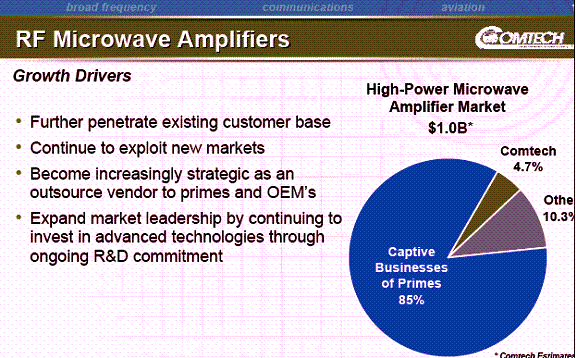
  3. The RF Microwave Amplifiers segment produces solid state, high-power broadband amplifiers which are incorporated into sophisticated applications, including aircraft air-to-ground satellite communications, medical oncology systems, instrumentation and a variety of defense applications (such as cargo inspection systems for Homeland security). Net sales were $9.4 million for the three months ended October 31, 2006, a decrease of $6.9 million, or 42.3%, compared with the prior year period. The decrease in net sales was due to lower sales (as anticipated) of amplifiers that are incorporated into improvised explosive device jamming systems.

Industry Background

The Global Development of Information-Intensive Economies. Businesses, governments and consumers have become increasingly reliant upon the Internet and multimedia applications to communicate voice, video and data to their customers and employees around the world. Demand for these high-bandwidth applications should continue to grow.

Demand for Increased Communications Cost Efficiencies. Due to the significant increase in global voice, video and data communications traffic, communications service providers have been forced to increase their investments in transmission infrastructure in order to maintain the quality and availability of their services. As a result, communications service providers are continually seeking technology solutions that increase the efficiency of their networks in order to reduce overall network operating costs. In light of the relatively high cost of satellite transmission versus other transmission channels, we agree with Comtech that communications service providers will make their satellite equipment vendor selections based upon the operating efficiency and quality of the products and solutions.

The Emergence of Information-Based, Network-Centric Warfare. Militaries around the world, including the United States military, have become increasingly reliant on information and communications technology to provide critical advantages in battlefield, support and logistics operations. Situational awareness, defined by knowledge of the location and strength of friendly and unfriendly forces during battle, can increase the likelihood of success during a conflict. As evidenced in the recent Iraqi conflict, stretched battle and supply lines have used satellite-based or over-the-horizon (OTH) microwave communications solutions to span distances that normal radio communications, such as terrestrial-based systems, are unable to cover. The need for these technologies should remain high due to the lack of terrestrial-based communications infrastructure in many parts of the world where the U.S. and other militaries operate.

Growth Drivers

The Company’s Telecommunications Transmission segment provides equipment and systems used to transmit voice, video, and data between Point A and Point B, or to multiple points C. The two primary product lines—Satellite Earth Station Products and Over-the-Horizon Microwave Systems—address markets where terrestrial infrastructure is unavailable or inefficient and provide transmission capacity to satisfy increasing bandwidth demand.

In addition to video transmission and cellular backhaul equipment, the Company sees growth for its Satellite Earth Station products and in OTH capacity.

Earlier today, Comtech r
eceived an order (for up to $4.3 million) to support the fielding and training of U.S. Army Troposcatter Terminals. Irregularities in the refractive index of air causes Tropospheric scatter, which can cause harmful interference in signal transmission. Troposcatter relay facilities, however, can use this lower atmospheric phenomenon to boost long-distance point-to-point services.

Comtech is well positioned to drive top-line growth by leveraging its existing client base’s need for tropospheric scatter modem upgrades and for next-generation terminals.

Management also sees expanding opportunities for its OTH microwave systems with oil and gas companies and foreign governments.

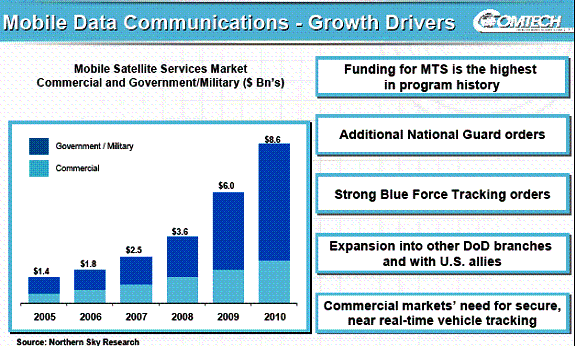
Prospects look just as encouraging for the Company’s Mobile Data Services segment. Spending in both the government and commercial sectors is expected to remain high through the decade.


Albeit the $418.0 million contract with the United States Army for the Movement Tracking System ends in July 2007, supplemental funding is readily available for Comtech’s next generation satellite transceiver, known as the MT 2012, which offers increased speed and performance.

MTS growth is being fueled, too, by Comtech’s successful ability to land contracts with other Department of Defense branches (and U.S. allies?).

In October 2006, Comtech
received a $1.6 Million order for the Army National Guard's acquisition of Movement Tracking System equipment. The order is for the supply of installation kits to continue the deployment of MTS equipment throughout the Army National Guard.

Management believes that if current funding levels of MTS and battlefield command and control applications are maintained or increased, or if and when the Company receives additional orders from the Army National Guard, Comtech may experience additional increased operating efficiencies in fiscal 2007.


Valuation Analysis

Assuming share-net growth of (at least) 7.5% per annum, operating margins of about 17 percent, an equity risk premium of 3.0%, and a WACC of 8.3%, the intrinsic value of Comtech is about $53.00 per share.

[Ed. note. The Company is creating value for its shareholders, for ROA exceeds WACC by 200 basis points.]

Comtech offers compelling growth prospects and operates in fundamentally healthy industries, but it is selling for about 19 times forward fiscal ’07 earnings of $2.05 per share (median point of communications equipment companies). Further multiple expansions assume management can execute on all cylinders—and continue to exceed guidance.

The 10Q Detective speculates, too, that Comtech might make an attractive take-out candidate for companies looking to diversify. Call us crazy—why not a buyout by General Motors? Know any other rusty giant looking to buy its way out of a moribund industry?

CEO Fred Kornberg, 71, has been with the Company for almost 35 years. Mr. Kornberg’s existing employment agreement stipulates that if a Change in Control occurs, he is entitled to resign (at will) and would receive a lump sum of approximately $11.7 million (excluding the value of his pension(s) and 622,124 shares of common stock that he beneficially owned as of October 6, 2006).

Insider selling has been limited to share options exercised in the $3.30 - $12.00 per share range.

Investment Risks & Considerations

  • A substantial portion of sales is recognized using the percentage-of-completion method. The reason for this is that many new orders—such as Over-the-Horizon microwave systems and mobile satellite systems—are large, multi-year contracts. Ergo, operating results may prove difficult to forecast—increasing stock price volatility.
  • In recent years, Comtech has increased its dependence on U.S. government business. Sales to the U.S. government (including sales to prime contractors to the U.S. government) accounted for approximately 47.3%, 42.1% and 40.1% of consolidated net sales for the fiscal years ended July 31, 2006, 2005 and 2004, respectively. Approximately 60.4% of its backlog at July 31, 2006 consisted of orders from the U.S. government.


Sales to the U.S. government represented 56.3% of aggregate sales for the three-months ended September 30, 2006. The Company has significant commercial opportunities for many of its products—such as the oil and gas industry. In order to lessen its dependence on the U.S. government (and leverage growth opportunities in other markets such as commercial satellite-based mobile data applications), management must seek out and secure new distribution channels.

  • Comtech’s fiscal 2004 Federal income tax return is being audited by the Internal Revenue Service, other returns may be selected for audit and a resulting tax assessment or settlement could have a material adverse impact on results of operations and financial position (in addition to restating prior year filings).
  • Management also said on Monday that its independent accounting firm, KPMG International, told the company on Nov. 30 that one of its staff accountants purchased some of Comtech's common stock. In a Securities and Exchange Commission filing, the company said KPMG is assessing whether its independence has been impaired.

The company said it would file an amended quarterly report as soon as possible with the SEC. If KPMG is found not to be independent, Comtech said it would incur significant additional costs associated with changing independent accountants. [Ed. note. Translation = lowered earnings guidance.]

Editor David J. Phillips holds no financial interest in any of the stocks mentioned in this article. The 10Q Detective has a full disclosure policy.

Thursday, December 07, 2006

Is One-Million Stock Options What it Used to Be?


Many academics argue that CEO annual pay is not correlated with firm performance. We do not disagree. Our own research has uncovered hundreds of examples positing that executive compensation arrangements are often designed to benefit the executive at the shareholders’ (collective) expense.

We suggest, however, that this premise of managerial power—coupled with a servile board of directors--ignores that not all contractual power rests with the executive. We now present a case study that shows that an optimal CEO contract can be negotiated where the future wealth of the CEO is directly aligned with that of the shareholder.

In May 2001, Stephan Godevais left Dell Computer (DELL) to join rechargeable battery systems maker Valence Technology (VLNC) as its Chief Executive Officer at a salary of $500,000 per annum.

Under his employment agreement, the Company granted Mr. Godevais stock options to purchase an aggregate of 1,500,000 shares of common stock at an exercise price of $6.52 per share, vesting over a period of four years....
Read more…

Monday, December 04, 2006

Is KKR Growing Impatient with Accuride Corp?

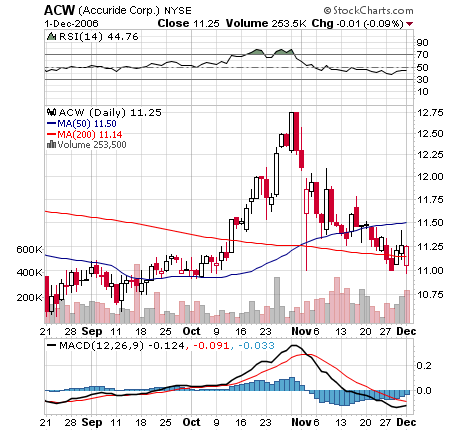
Is commercial vehicle component maker Accuride Corp. (ACW-$11.25) about to have its wheels flattened by KKR?On November 28, 2006, Accuride Corporation entered into new Change in Control agreements with certain executive officers and other senior management employees, including CEO Terrence J. Keating, President and CFO John R. Murphy, General Counsel David K. Armstrong, Senior VP/ Human Resources Elizabeth I. Hamme, and Senior VP/ Sales & Marketing Henry L. Taylor.

In addition, each participating executive is entitled to a Change in Control severance benefit if his or her employment with the Company is terminated during the Protection Period. The change in control severance benefits for the aforementioned executives are equal to 200% -- to -- 300% of the executive’s salary at termination, plus either 200% --to—300% of the greater of the average incentive compensation award over the three years prior to termination.

The 10Q Detective has borne witness recently to instances where Change in Control agreements were [curiously?] executed only weeks—or months—before the publicly traded companies entered into terms of new management.

Accuride is one of the largest manufacturers and suppliers of commercial
vehicle components in North America, serving virtually all the heavy-duty and medium-duty OEMs and their related aftermarket channels in most major segments of the commercial vehicle market, including heavy- and medium-duty trucks, commercial trailers, light trucks, buses, as well as specialty and military vehicles (creating a significant barrier to entry).

Its products include commercial vehicle wheels, wheel-end components and assemblies, truck body and chassis parts, seating assemblies and other commercial vehicle components. The Company markets its products under some of the most recognized brand names in the industry, including Accuride, Gunite, Imperial, Bostrom, Fabco and Brillion.

Accuride principally competes in the heavy-duty, or Class 8, truck market, the medium-duty, or Class 5-7, truck market, the commercial trailer market, the light, or Class 3-4, truck market, the bus market, as well as the specialty and military vehicle markets. Heavy- and medium-duty trucks are used for local and long-haul commercial trucking and are classified by gross vehicle weight. The heavy-duty truck market is comprised of trucks with gross weight in excess of 33,000 lbs. and the medium-duty truck market is comprised of trucks with gross weight from 16,001 lbs. to 33,000 lbs.

The Company’s diversified customer base includes substantially all of the leading commercial vehicle OEMs, such as Freightliner Corporation, with its Freightliner, Sterling and Western Star brand trucks, PACCAR, Inc., with its Peterbilt and Kenworth brand trucks, International Truck and Engine Corporation, with its International brand trucks, and Volvo Truck Corporation, or Volvo/Mack, with its Volvo and Mack brand trucks.

Accuride’s core strength is that it the Company holds leading market positions—the number one or number two market position—in most of its major product categories: about an 87% market share in heavy-duty steel wheels, a 48% market share in heavy-duty aluminum wheels, a 55% market share in brake drums, and approximately a 37% market share in disc wheel hubs.

Growth in the commercial vehicle industry tends to grow in-line with the broader economy. As a result, the trucking industry generally correlates with economic indicators, including gross domestic product and industrial production indicators, such as the Industrial Production Index.

The finite lives of commercial vehicles—replacement cycle—is an industry driver, too. Most leading national freight companies replace their vehicles every three to five years. According to America's Commercial Transportation Publications, or ACT, at the end of 2003, the average age of existing heavy-duty truck fleets reached a ten-year high of 5.9 years, relative to the ten-year average of 5.5 years. Historically, vehicle demand increases as trucking fleets revert to a normal age level for their vehicles.

The commercial vehicle market continued at a robust pace during the first nine months of 2006. Freight growth, improved fleet profitability, aging equipment, high equipment utilization, and economic strength continue to drive demand for new vehicles. Current industry forecasts by analysts, including ACT Publications, predict that the North American commercial vehicle industry will continue to be strong throughout 2006, with a decline predicted in 2007 due to a change in emissions standards.

Against this industry backdrop, Accuride surprised Wall Street by
posting a 35 percent drop in its 3Q profits. The Company earned $12.4 million, or 36 cents per share, compared with $19.1 million, or 55 cents per share, for the same quarter in 2005. Accuride said that while demand for its products was strong, the company's margins continued to be hurt by higher raw material prices (such as raw steel and aluminum) and other operating costs.

Analysts polled by Thomson Financial had expected a profit of 54 cents per share.

Adjusted EBITDA was $47.9 million for the third quarter of 2006, compared to an adjusted EBITDA of $51.7 million for the same quarter in 2005.

Net sales for the three months ended September 30, 2006 grew 8.1 percent to $341.6 million from $316.1 million in the year-ago period.

The Company—although leveraged—appears to be financially stable. As of September 30, 2006, the Company had cash of $86.7 million. Total debt of $657.7 million and net debt of $571.0 million reflected a net debt reduction of $43.1 million during the quarter (an aggregate amount of $275.0 million in principal amount of 8.5% senior subordinated notes do not mature until 2015).

Accuride is trading on the equity at a gain, with (TTM) ROE of 31.61% outpacing (TTM) ROA of 7.85 percent.

For the third quarter of 2006, cash from operating activities was $50.1 million and capital expenditures totaled $9.5 million, resulting in free cash flow of $40.6 million. Book value stood at about $7.04 per share.

The stock price has fallen about 15.3% in the last year, signaling to us that more than shrinking margins are bothering investors. Accuride is dependent on sales to a small number of major customers: Freightliner, PACCAR, International and Volvo/Mack constituted approximately 52 percent of trailing twelve-month sales. We suggest that replacement demand for heavy-duty trucks—which influences the demand for component sales—is nearing the later stages of a cyclical upturn.

A contracting P/E multiple, too, reveals the deteriorating forward fundamentals of the Company. Consensus estimates for fiscal year ending December 2007 call for share-net of 93 cents (down from EPS of $1.39 just sixty days ago) on sales of 1.10 billion, compared with current year 2006 estimates of $1.82 per share on sales of $1.39 billion.

The stock, with an enterprise value of $959.9 million, is selling at a forward multiple of about 12.10 times 2007 EPS. Comparables are difficult, for example, South African-based Hayes Lemmerz International, Inc. (HAYZ-$2.55), a leading global supplier of automotive, powertrain, suspension, structural and other lightweight components, with an enterprise value of 756.7 million, is projected to lose $2.07 per share (January 2008); whereas, auto-parts maker ArvinMeritor (ARM-$17.32), with an enterprise value of about 2.11 billion, is selling for ONLY 10.8 times forward (September 2008) earnings of $1.67 per share (a 50 cent jump over 2007 EPS).

Back to our original supposition—might a Change in Events be forthcoming at Accuride Corporation?

On April 26, 2005, Accuride completed an initial public offering of its common stock and commenced trading on the New York Stock Exchange. Net proceeds from the initial public offering were $89.6 million (11.0 million shares priced at $9.00 per share).

One of the biggest stakeholders in the Company is one of the world's oldest and most experienced private equity firms specializing in management buyouts—Kohlberg Kravis Roberts & Co? KKR beneficially owns approximately 23% of Accuride’s outstanding shares of common stock and has two partners on the Company’s board of directors. [Full Disclosure -- Pursuant to a management services agreement, KKR renders “management, consulting and financial services” to the Company for an annual fee of $665,000.]

Trimaran Capital Partners, a private asset management firm headquartered in New York (dedicated to leveraged buyouts), with assets under management in excess of $3.8 billion, owns about an 11.4% stake through several entities, too. [Full Disclosure -- Trimaran Fund Management renders “management, consulting and financial services” to the Company for an annual fee of $335,000.]

Avoid being impatient. Remember time brings roses – (Unknown).

KKR, Trimaran Partners, and other institutional investors just might not wait for the roses to bloom come spring.

Editor David J. Phillips holds no financial interest in any of the stocks mentioned in this article. The 10Q Detective has a full disclosure policy.

Wednesday, November 29, 2006

Board of Directors -- Foxes in the Henhouse?


A corporation’s Board of Directors is elected by its shareholders and empowered to carry out certain fiduciary tasks—like appointing executive management and declaring dividends—spelled out in the company’s charter.

Under most companies’ Corporate Governance Guidelines, each director is expected to dedicate sufficient time, energy and attention to ensure the diligent performance of his or her duties, including by regularly attending meetings of the Board and committees of which he or she is a member.

These Codes of Conduct expressly proscribe, too, that directors must avoid conflicts of interest. Essentially, directors should not use their corporate positions for individual personal advantages.

While the Codes do not attempt to describe all possible conflicts of interest that could develop, the following are examples of conflicts of interest:

  1. Company Loans – receiving loans or guarantees of obligations as a result of one's position as a Director;
  2. Third Party Relationships – engaging in conduct or activity that improperly interferes with the Company's existing or prospective business relations with a third party;
  3. Personal Gains – accepting bribes, kickbacks or any other improper payments for services relating to the conduct of the business of the Company;
  4. Gifts and/or Gratuities – accepting, or having a member of a Director's immediate family accept, a gift from persons or entities that deal with the Company, in cases where the gift is being made in order to influence the Directors' actions as a member of the Board, or where acceptance of the gift could otherwise reasonably create the appearance of a conflict of interest; and
  5. Personal Use of Corporate Assets – using Company assets, labor or information for personal use except as approved by the Chairman of the Governance and Nominating Committee, or as part of a compensation or expense reimbursement program available to all Directors.

The 10Q Detective has found one conflict of interest that is remarkable in its absence from Corporate Governance policies that we have examined—that of time. Granted, most Codes spell out or infer that “self-dealing,” in which public and private interests collide, is to be avoided; but aside from looking at ‘time’ as a quantifiable measure (by regular attendance at board or subcommittee meetings), few corporations bother to exercise vigilance in declaring any apparent or real personal conflict in a director’s time when he or she is serving on the boards of many a company (save for direct competitors) and/or have private interests, too.

How can these ‘policy managers’—whatever their breadth of experience or prior industry successes—be expected to exercise, in the performance of their duties, the degree of care, diligence and skill necessary to be effective stewards of stockholders’ interests?

On August 1, 2006, Starwood Hotels & Resorts Worldwide, Inc. (HOT-$63.11), one of the world's largest hotel and leisure companies, announced the election of
Adam M. Aron, 51, the former Chairman and CEO of Vail Resorts (MTN-$41.71) to its Board of Directors.

"There's not a more innovative leader in this industry than Adam," said Steven J. Heyer, Starwood's Chief Executive Officer. "As we continue to transform our company, unlocking the substantial power of our brands and implementing an exciting strategy that pushes traditional boundaries, Adam's insight and instinct will be invaluable."

The 10Q Detective is not questioning Aron’s competence. “Adam is an icon in the travel industry, well respected and admired by those who have worked with him during his 27 years in the industry," said Bruce Duncan, Chairman of Starwood's Board. "Credited with many industry 'firsts' including helping to create airline and hotel frequency programs, Adam is a formidable addition to our board."

And looking at Aron’s recent compensation and severance packages from Vail Resorts, from which he retired in June 2006, he certainly is not in need of disposable income:

  • As of April 2005, Mr. Aron owned more than $11.0 million in Vail-related real-estate holdings;
  • As part of his Separation Agreement, Mr. Aron was granted more than $2.65 million in accrued severance; and,
  • In his ten years at the helm of Vail Resorts, Aron accumulated more than 210,000 shares of company stock, worth an estimated $8.82 million. Also, he retains an additional 600,000 (+) in-the-money vested options, worth an estimated $25.2 million.

Mr. Aron epitomizes our time conflict argument; he is an obviously successful businessman with too little time to commit to all of his interests.

Are shareholders best served when—in addition to serving on the Board at Starwood’s Hotel—he is currently Vice Chairman of the Travel Industry Association of America and is expected to be its Chairman in 2008?

We doubt that he accepted the board position at Starwood for the 250,000 Starwood Preferred Guest Points and eighteen free nights per year in the Company’s hotels given annually to each director.

Did we mention, too, that Mr. Aron serves on the Board of Directors of the floral provider FTD Group (FTD-$17.48) and Rewards Network (IRN-$5.45), a leading provider of marketing services and loyalty programs to the restaurant industry?

If any of our readers need more telling attestation, consider this fact: Mr. Aron just founded Miami-based World Leisure Partners (in the spring of 2006) to serve as a personal consultancy on issues related to leisure-related and/or luxury products and services, including real estate, as well as consumer marketing issues. Potential clients will need to know that he has more than just a titular role to play if this venture is to succeed.

Doing a GOOGLE search, we uncovered 1.16 million articles referencing ‘CEO/ PAY/ EXCESSES.’ As Boards of directors are responsible for setting CEO pay, we wonder how many times directors have awarded compensation packages that go well beyond what is required to attract and retain qualified executives because the directors were too busy with other projects?

Given that executive pay excesses often come at the expense of shareholder value, stockholders ought to be asking just one question: When is Mr. Aron going to find the time to exercise the ski privileges for the 2006/2007 ski season (that he had written into his Severance Agreement)?

Editor David J. Phillips holds no financial interest in any of the stocks mentioned in this article. The 10Q Detective has a full disclosure policy.

Friday, November 24, 2006

Is CVS the Prescription Fix for CareMark?


On November 9, 2006, shareholders upset over the planned merger of prescription benefits manager (PBM) Caremark Rx, Inc. (CMX) with CVS Corp. (CVS) filed suit in Nashville federal court, claiming the business combination was merely a cover for a takeover by the drugstore chain and wasn’t fair to investors.

In its lawsuit, the Iron Workers of Western Pennsylvania Pension Plan argued that the stated “merger of equals” was actually a buyout of Caremark by the pharmacy chain CVS—without a takeover premium being paid to Caremark stockholders.

Under the terms of the agreement, which is a stock for stock transaction, Caremark shareholders will receive 1.67 shares of CVS for each share of Caremark. The exchange ratio approximates the 90-day average ratio of the two companies’ closing stock prices (prior to November 1, 2006).

The new company will be called CVS/Caremark Corp. and will be headquartered in Woonsocket, Rhode Island. The pharmacy services business will remain based in Nashville.

The combined company’s ordinary shares will trade on the NYSE under the symbol “CVS”.

Caremark's stock closed Wednesday at $45.90 a share. CVS closed at $28.00. Based on that, its offer for Caremark would be worth about $46.76 a share, for a premium of 86 cents a share. On a pro forma basis, CVS stockholders will own 54.5% of the combined company and Caremark stockholders will own 45.5 percent.

The lawsuit also accused Caremark executives, including Chairman and CEO Edwin "Mac" Crawford, of "breaching their fiduciary duties" (given the negligible price premium involved in the merger).

The 10Q Detective will present a case that questions the critical suppositions underlying the Iron Workers’ accusations:

  1. Did Caremark management fail to maximize shareholder value by negotiating a drug deal that included no premium for its stock price?
  2. Was the deal a “merger of equals” or a “bargain buyout” of Caremark by CVS?

The Iron Workers were puzzled as to why management negotiated the deal when the price of its common stock was so low? Caremark was selling at $49.00 at the time of the announcement, more than 20% below where it was valued less than two months earlier.

Adding to the Iron Workers suspicions, too, was that during the third quarter ended September 30, 2006, management approved open market purchases of 1.85 million shares of its common stock (under a previously announced repurchase program begun back in 2002) at an average price of approximately $55.35 per share.

Instead of griping about the dearth of a price premium in the $21.5 billion deal, the Iron Workers (and other dissatisfied investors) should question why the stock price was falling? [Ed. note. Before ridiculing the recent stock buybacks, investors should note that the average price paid for all repurchases made under the program from its inception through September 30, 2006, was $41.07 per share.]

In our view, investors were dumping Caremark stock because of recent events clouding future earnings’ visibility—including, but not limited to: (i) the timing and launch of generic pharmaceutical products by Wal-Mart into the marketplace, which will add incremental pressure to (already) weakening margins by decreasing the generic margin lifecycle; speculation that Democratic party gains in Congress will lead to an overhaul of the Medicare Part D prescription drug program, leading to lower average revenue per claim; and (iii) competition by other PBMs for managed-care providers’ prescription-drug plan contracts will continue to pressure margins.

Ergo, there was no price premium to the deal because CareMark’s current business model is dependent on the questionable ability of the Company to operate independently (and profitably) in a changing healthcare landscape.

In our view, the Iron Workers were correct in saying that deal was not “a merger of equals,” but the buyout of a PBM by a drugstore titan. Vertically integrating one of the biggest PBMs with the largest U.S. drugstore chain “as a deal of equals” in the best of times would be difficult. CVS’s $2.9 billion purchase of 700 standalone Sav-on and Osco drug stores (from Albertsons in January 2006), placating its own unhappy shareholders (given the recent drop in its own stock price), and executing on potential scale (and an expected $400 million in annual cost savings)—all these potential distractions will require dictatorial management—not management by consensus.

We predict that CVS will swallow the operations of CareMark into its own $3 billion wholly owned PBM (PharmaCare Management Services, the fourth-largest full-service PBM in the nation).

Both companies have said “the board of directors of the new company will be split evenly between Caremark and CVS. Mac Crawford will become Chairman of CVS/Caremark and Tom Ryan will become President and Chief Executive Officer. CVS Chief Financial Officer David Rickard will be Chief Financial Officer of CVS/Caremark and Caremark Senior Executive Vice President and Chief Operating Officer Howard McLure will become President of Caremark pharmacy services business.” [It is a given that administrative cuts will be made to realize the promulgated ‘cost-savings.’ The litmus test for this purported equal business combination will be twelve-to-eighteen months down the road—when investors see how many current Caremark executive and directors are still hanging around.]

Corporate Governance Issues

We would not go as far (as the Iron Workers) in saying that CareMark senior executives have “breached their fiduciary responsibilities”; still, a recent read of CareMark’s April 2006 Proxy Statement illustrates that top executives will profit handsomely ((once again) if this deal proves to be accretive to CVS’s profitability (and the price of CVS’s common stock retraces recent declines):

CEO & Chairman Edward M. Crawford beneficially owns 4.11 million shares of CareMark common stock, excluding an additional 5.76 million unexercised (in-the-money) stock options worth about $248.7 million (when the stock sold for $51.79 per share). Mr. Crawford is also entitled to certain “gross up” payments related to any excise tax that may be imposed when he elects to exercise the aforementioned shares.

Mr. Crawford earned a base salary of $1.6 million and a cash bonus of $3.2 million in 2005.

General counsel Edward L. Hardin has an employment agreement that states: “in no event will his annual base salary be reduced below $450,000 in any calendar year.” As an ‘inducement’ to sign the agreement, Mr. Hardin received an option to purchase 400,000 shares of common stock at an exercise price of $3.25 per share!

Mr. Hardin earned a base salary of $540,000 and a cash bonus of $1.35 million in 2005.

COO Howard A. McClure earned salary/cash bonus of $2.18 million in 2005, and is sitting on about 724,000 in unexercised options worth $14.88 million (at year-end 2005).

In late 2003, when CareMark relocated its corporate headquarters from Birmingham, Alabama to Nashville, Tennessee, certain executive officers—can you guess who—participated in the Company’s relocation services program, which included any net losses from resale of the houses, real estate commissions and other seller closing costs as a result of their transfers. To date, the Company (i.e. shareholders) has incurred aggregate costs of about $2.45 million. In addition, the Company currently has an aggregate outstanding equity advance totaling $2.90 million for Mr. Crawford, whose house has not yet been sold.

"Fear not, dear friend, but freely live your days…. Step, without trouble, down the sunlit ways" – Robert Louis Stevenson

If CareMark’s senior executives do not survive the impending management shakeout after the ‘Change in Control,’ each of them is entitled to lump sum payments (of salary/bonus).

Investment Risks and Considerations

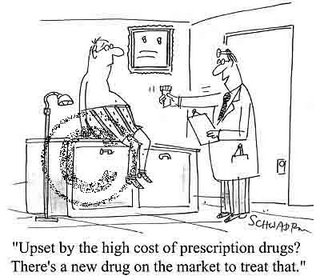
In the last month, the stock price of CVS has dropped about 10 percent, as investors fear that retailer Wal-Mart’s $4.00 prescription drug plan—which has been expanded to include popular drugs (like the cholesterol drug Pravachol) exiting their 180 Day Generic Drug Exclusivity Period—will adversely impact the drugstores generic margins and decrease store traffic (and non-prescription sales).

Given that cash prescriptions account for a small percentage of CVS’s prescription volume/ profits, we view the sell-off as an irrational over-reaction.

Excluding the CareMark acquisition, CVS is selling for about 14.8 times FY 2007 consensus estimates of $1.89 per share. If CVS management can successfully execute on the opportunities of scale presented by the CareMark deal—in terms of EPS and incremental new customer traffic—the current price of its common stock could prove to be attractive to patient investors.

Risks to our assessment include potential dilution of additional CVS shares issued in the CareMark merger offsetting expected accretion to EPS from scale and administrative savings; government overhaul of existing reimbursement rates of the Medicare Part D prescription drug benefits program; higher than anticipated integration expenses from recent acquisitions; and, continued margin erosions in lower-priced generic drugs.

Editor David J. Phillips holds a financial interest in the common stock of the drug maker Bristol-Myers Squibb, the manufacturer of the brand-name Pravachol. He is considering the purchase, too, of shares in CVS Corp. The 10Q Detective has a Full Disclosure policy.

Sunday, November 19, 2006

Former Homestore CEO Stuart Wolff "Coulda Been a Contender."


Back in March 2001, in an online interview with BusinessWeek, the then founder and CEO of online real estate listings company Homestore Inc., Stuart Wolff, credited the ability of his company to survive the dot.com meltdown to its ‘unique’ business plan: “The companies that had models that showed there was a new way of doing business are the ones that have gone by the wayside (like Pets.com and Webvan). Our model was always to partner with our industry. It was our intent to use technology to help make realtors more efficient, not to put them out of business.”

History has shown, however, that there was nothing singular about Homestore’s business model. Instead, like many other erstwhile Wall Street highfliers, Wolff and his Company's success was grounded in
accounting fraud. Wolff and a dozen or so other executives—motivated by greed—schemed to artificially inflate revenues through a ‘circular flow’ of money (by way of more than $67.0 million in sham online advertising—Homestore booked its own cash as sales).

As of December 31, 2000, Wolff held about 550,000 “in-the-money” stock options worth an estimated $5.56 million (at the fair market value of $20.13 per share).

In the prior two years, too, Wolff had exercised options to acquire some 2.35 million shares of common stock in exchange for a promissory note of about $3.24 million (at an interest rate of between 5.21 percent – 5.49 percent).

Indicted in April 2005, a federal court jury returned a guilty verdict against Wolff in his criminal trial (in June 2006) on 18 counts, including conspiracy, insider trading, filing false reports with the SEC, falsifying corporate records, and lying to the auditors.

On Oct. 12, 2006, prior to sentencing, Judge Percy Anderson said, “There comes a time when you have to accept responsibility…. Your failure to do that compels me to impose a substantial sentence.” Wolff was sentenced to 15 years in federal prison (of which at least twelve-years must be served before he is eligible for parole) and ordered to pay $8.64 million in restitution and a $5 million fine.

“You had marketable skills, you had money,” scolded Judge Anderson,
"there was no excuse for this.”

“You don’t understand! I coulda had class. I coulda been a contender. I could’ve been somebody, instead of a bum, which is what I am.” – Terry Malloy (Marlon Brando—actor,
On the Waterfront – Directed by Elia Kazan)

Wolff, 43, who holds a doctorate in electrical engineering from Princeton University (with research experience at AT&T Bell Labs and IBM), headed Homestore from 1997 until he resigned in January 2002 (amid an
internal probe of the Company’s finances). His salary/cash bonus totaled $487,115, $447,308, and $285,538 in fiscal year 2000,1999, and 1998, respectively.

The Company, which provides real estate listings and related services on the Internet, has since changed its name to
Move, Inc. (MOVE-$5.45).

Wolff’s attorneys (who had sought a sentence of two-to-six-years) said that an appeal is expected.

Editor David J. Phillips holds no financial interest in any of the stocks mentioned in this article. The 10Q Detective has a full disclosure policy.


Thursday, November 16, 2006

The Vultures are Circling above Bodisen Biotech


As predicted, the window of class action lawsuits has opened against organic fertilizer maker Bodisen Biotech (BBC-$5.29).

Earlier today, in their ongoing attempt to “champion the rights of investors nationwide,” New York-based Rosen Law firm filed a class action against Bodisen Biotech and certain of its officers and directors, as well as Benjamin Way and New York Global Group for violations of federal securities laws. The Complaint alleges that the Company failed to disclose that it was paying New York Global to issue positive research reports on the Company. As a result of the alleged fraud, Rosen charges that the value of the Bodisen’s stock has declined and damaged investors.

Committed to you—the investor—the Law Offices of Howard G. Smith announced that it has filed a securities class action lawsuit (on behalf of shareholders who purchased the common stock of Bodisen Biotech, too).

Their complaint alleges that defendants violated federal securities laws by issuing a series of material misrepresentations to the market during the Class Period (between August 26, 2005 and November 14, 2006) concerning the Company's business, prospects and financial performance, thereby artificially inflating the price of Bodisen securities.

The 10Q Detective spotted this joke online the other day: What's the difference between a lawyer and a vulture? The lawyer gets frequent flyer miles.

And the self-professed “champion for victims of corporate wrongdoing,” Kahn Gauthier Swick, LLC (KGS), announced that it has commenced an investigation into Bodisen Biotech to determine whether it has violated federal securities laws by issuing false and misleading statements to its shareholders.

According to KGS’ website, one of its founders was Wendell Gauthier (1943 – 2001), a nationally prominent lawyer most responsible for the national tobacco settlements in excess of $200 billion, and numerous other recoveries for thousands of plaintiffs in excess of $3 billion.

It is no joke – the vultures are already flying over Bodisen’s body, which is not even dead yet!

Long Positions in'10Q_Detective' sorted by Bought in Ascending order
Bodisen Biotech, Inc. (BBC)
SymbolPositionBoughtOpen PriceValueCostNet%Change
BBC30010/02/20068.811,587.002,655.99-1,068.99-40.25%
BBC50011/14/20066.042,645.003,032.09-387.09-12.77%
Total
4,232.005,688.08-1,456.08-25.60%


The 10Q Detective has a full disclosure policy.

Wednesday, November 15, 2006

How to Perform the Three-card Monte? Ask the Management of Bodisen Biotech, Inc.


Bodisen Biotech (BBC-$5.90) is spreading more than nontoxic soil conditioner around these days.

Last month, the China-based maker of organic fertilizers said that it expected ‘strong’ growth in revenue and profit for the third quarter ended September 30, 2006. Shares of Bodisen have tumbled about 45 percent in two days, reflecting investor disappointment in the Company’s
posted net income of $3.2 million, or 17 cents a share, for the three months ended Sept. 30, compared to a profit of $2.9 million, or 18 cents a share, in the year-ago equivalent period.

And today management disclosed that its prior financial filings “may have to be corrected or amended due to incomplete, misleading or inaccurate disclosures.”

Easy-lending credit policies, negative operating cash flow, and a questionable prior relationship with advisor Benjamin Wey and his
New York Global Group—the 10Q Detective saw red flags waving in the wind when we first posted on Bodisen Biotech. On October 2, 2006, we wrote: “albeit red flags do exist, in our view, we can shrug them off (for now) because the Company does have a strong balance sheet without any long-term debts.” Instead we chose to marvel at the Company’s strong (Chinese) agricultural product distribution network and upbeat comments by management.

Our favorite financier, statesman, and presidential adviser Bernard Baruch said: “Never pay the slightest attention to what a company president ever says about his stock.”

We wish we had listened—or at least paid heed--to the warning of
Dow Jones columnist Herb Greenberg when he rhetorically asked (of Bodisen’s management): “If the company can't answer that question (regarding their investment in China Natural Gas), or offer a good explanation, I would wonder what else might be exaggerated or not quite right?”

We are more than pissed off, for we feel like the mark in a game of
three-card Monte. That said, in our view, management is not finished with their sleight of hand card tricks. CEO Wang has already hinted at a sequential slowing of sales growth in the coming quarter, saying: ``While the fourth quarter, which represents the end of the harvest season, typically is our slowest period of the year, we expect to continue to achieve year-over-year revenue and earnings growth in the last quarter of the year.'' [Ed. note. Forget the hyperbole and read between the lines!]

In addition, we suspect that [more than one] class-action litigation is around the corner. [Ed. note. We can only hope, too, that the Company’s product ingredients really do not contain manure or other waste products.]

“If you get all the facts, your judgment can be right; if you don't get all the facts, it can't be right.” –Bernard Baruch.

Given the blatant discrepancies between management’s public comments and disclosures (in SEC filings), we have lost faith in this Company. Contrary to our concern(s)—and hoping to flip the “money card”—we are disclosing that we did do speculative buying in the Common Stock of Bodisen near the close of trading today—trusting that there is truth to the Wall Street saying that “even a dead cat will bounce if it is dropped from high enough.”

Editor David J Phillips is long shares of Bodisen Biotech and China Natural Gas. The 10Q Detective has a full disclosure policy.

Tuesday, November 14, 2006

Precision Drilling Trust--Spudding Dry Holes for Investors?


David,

"I am looking to diversify my portfolio and am looking at oil/energy stocks. I read your nice review on
Precision Drilling Trust and decided to buy the stock. Unfortunately, this was the day before the plunge happened after Flaherty's comments. I bought at $28 and got out at $25 during the panic. But the only reason why I sold was because of the overall sell-off - I was trying to be disciplined about selling when the loss got past 8-10% (an IBD strategy). Now the stock is down to $23 and I am considering getting back in, especially given the "watered down" context of Flaherty's comments. I like the dividend and I think the stock has hit a bottom - one accentuated by politics. The dividend realized is actually 15% less than the proclaimed yield, however, as the Canadian govt. takes a 15% cut as a foreign tax - my own experience from holding Canadian Imperial Bank shares. So, do you still support the stock and do you feel that this is a nice opportunity to get back in?”

Ed. Note: We expect the dividend payout ratio (about 92.0%) to be cut substantially, for (i) the current dividend payout is built-on the existing premise of a corporate [expense deduction] pass-through to unit trust holders and (ii) the Company will need to reconcile its dividend distributions and expected capital spending expenditures with the final income trust tax bill.

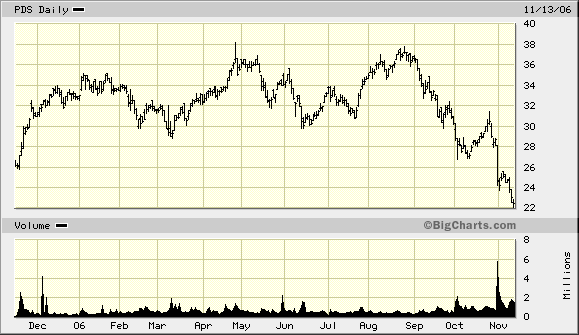
The Common Stock of Precision Drilling Trust (PDS--$22.42), Canada's largest oilfield services company, has plunged about 27.8% since November 1, when Jim Flaherty, Canadian Finance Minister, stunned investors on Bay Street to Wall Street with news that the Canadian government was planning to tax dividends on income trusts.

Royalty (income) trust have become increasingly popular in our Neighbor to the North, for the trust structure avoids the double taxation that came from combining corporate income tax with shareholders' dividend tax. By passing through the earnings—in the form of both cash dividends and a pro-rata share of return-of-capital, the trust structure reduced—or eliminated—its income tax liability, thereby increasing the amount of cash available for distribution to unitholders and for future capital expenditures.

Anticipating that increasing cash distributions to unitholders would provide an attractive rate of return without impairing Precision’s ability to finance maintenance and expansion capital expenditures, the Company (on November 7, 2005) converted to a trust structure through a plan of reorganization.The Trust, through its wholly-owned subsidiaries, now operates the Company’s contract drilling services to the Canadian oil and natural gas industry.

When Canadian telecom giants
Bell Canada Enterprises (BCE-$23.99) and Telus Corp. (TU-$47.98) announced plans to convert to income trusts, the Tory-led government feared a domino effect would occur in other sectors of the economy (allegedly among financial institutions and other energy concerns). According to Flaherty, “$70 billion of new trust conversions had been announced so far this year — and (this) converting was solely to avoid paying corporate taxes.”

Flaherty imposed this punitive tax on income trusts to “stem the growing number of companies” that were converting to trusts—and broke a central election promise. The Tories promised in their platform book to preserve income trusts by not imposing any new taxes on them (after accusing the Liberals of attacking retirement savings). Acknowledging the broken election platform, the Tories still countered that income-trust acceleration would have meant the loss of billions in the tax base provided by corporations. “Increasingly, individuals and families in Canada would shoulder the burden,” Mr. Flaherty said.

It is estimated that foreigners only hold about 20 percent of all (Canadian) income trust units. This means that Canadians—with many being retirees dependent on the distributions from these trusts to meet monthly expenses—(despite proposed tax relief) will eventually feel the impact of less income (in addition to the loss in savings/assets from the drop in market value of all the affected trusts).

The Tory-led government will be under pressure, too, from Canadian oil & gas executives, as foreign investors look away to more attractive markets.

American investors ought to note that the Conservatives have—at best—a tenuous hold on power. In the 2006 Canadian federal election, held on January 23, 2006, the Conservative Party of Canada won a plurality of seats in Parliament: 40.3% of seats, or 124 out of 308—but mathematically, the numbers resulted in a minority government led by the Conservative Party with
Stephen Harper (becoming the 22nd Prime Minister of Canada).

On September 25, 2006, the Conservative government announced that within the fiscal year, there would be a $13.2 billion-dollar surplus (that will be used to pay down the country's debt). This statement supports a modification of the income-trust tax proposal.

Even if Harper’s Tories stand together, tax reform will still require support of either the New Democratic (NDP) or Bloc Québécois parties for passage of the Trust Tax. [Ed. note. Taxes are the only politics that the Conservatives have in common with the New Democratic party (with 29 members in the House), for the NDP’s ideology is more to the left—and liberal—to that of the Tories. The Bloc Québécois party has 50 seats in the House of Commons.]

Although the new tax (estimated to be 34 percent) is not slated to take full effect until 2011, we must assume the core advantage of being an income trust has been mortally wounded.

Absent final clarification by the Harper-led gang on Parliament Hill in Ottawa, uncertainty will continue to shadow all income trusts, including our Precision Drilling holding, for all affected companies need to know what tax reform bill it is that they need to adjust to (reconcile dividend distributions with capital spending needs)?

Granted, we just said last week that
cheap can get cheaper, but with the price of Precision Drilling Trust off about 41 percent from its April 2006 high (of $38.30 per share), the contraire in us loves the uncertainty, and we bought more shares of the Common Stock (which has a book value of $8.46 per share and little in long-term debt, only 14.1% of equity).

Long Positions in'10Q_Detective' sorted by Bought in Ascending order
PrecisionDrilling Trust (PDS)
SymbolPositionBoughtOpen PriceValueCostNet%Change
PDS20010/18/200628.484,458.005,708.97-1,250.97-21.91%
PDS20011/03/200625.144,458.005,040.99-582.99-11.56%
PDS20011/13/200622.324,458.004,476.99-18.99-0.42%

Editor David J Phillips is long shares of Precision Drilling Trust but has no financial interest in any other company mentioned in this posting. The 10Q Detective has a full disclosure policy.

Saturday, November 11, 2006

Adobe CFO Furr Resigns--Window into His Universe


On May 18, 2006, Adobe Systems (ADBE-$39.41), which makes a number of popular software applications, including PhotoShop and Acrobat, introduced Randy Furr as its new Chief Financial Officer. Pursuant to his employment agreement, Mr. Furr’s was to receive (i) an annual base salary of $500,000; (ii) a bonus of up to 75% of his annual base salary; (iii) a sign-on bonus of $100,000; (iv) eligibility to participate in the Adobe profit sharing plan and an executive “Performance Shares” program (with a targeted grant of 20,000 shares in FY 2007); and, (v) an option grant—which vested over four years—to purchase 300,000 shares of Adobe common stock at an exercise price of $28.78 per share (which was equal to the closing price of the Company’s common stock on June 19, 2006).

CEO Bruce Chizen lauded Furr's move to Adobe, saying: “Randy, welcome to the Adobe team. We are proud of the company we have built and are confident you will soon discover why it’s simply better at Adobe. We look forward to your contributions to Adobe’s ongoing success.”

Yesterday, after just six months on the job, Adobe Systems announced
the resignation of CFO Randy Furr. The Company said, “Furr's departure had nothing to do with his job performance. In addition, no issues had been raised regarding the integrity of the company's financial statements.”

The 10Q Detective called the Company seeking additional clarification and was told that Furr left of his own accord, for “personal reasons.”

A salary/cash bonus potential of about $875,000 per annum and the forfeiture of (up to) 300,000 share options more than $10.00 (per share) ‘in-the-money’—we had to pinch ourselves. Human nature—we speculated—who would pass up such a sweet compensation package? Did Furr leave voluntarily, without prompting or coercion, or was the “personal reason” more rhetoric than fact?

Before arriving at Adobe, Furr spent thirteen years at the integrated electronics parts manufacturer Sanmina-SCI (SANM-$4.17), serving as President and COO from 1996 to 2005, and as CFO from 1992 to 1996.

Some analysts
pondering the mystery of Randy Furr believe that he resigned from Adobe because of his possible involvement in a stock option scandal announced by a Special Board Committee at Sanmina on October 12, 2006.

Sanmina said last month that its internal inquiry found that most stock option grants to executives and other employees between 1997 and 2006 were not correctly dated or accounted for and would require that the Company restate its historical financial results and record non-cash compensation charges. In addition, two former senior level executives employed during this time period had been implicated in the backdating option scandal.

In a conversation with Sanmina spokeswoman, Paige Bombino, she declined to identify the two executives who helped to engineer the option scheme, confirming to us only that it was not the company's [current] chief executive officer or chief financial officer.

Similar to his stated reason for leaving Adobe, Furr left this other San Jose-based technology firm (and a $500,000 –plus- annual salary) in October 2005, citing “
personal circumstances and family reasons that required his immediate attention.”

Sadly, the 10Q Detective has since learned that Furr was telling the truth, for his wife, Karen, was fighting (a losing) battle with cancer.

When talking about
quantum mechanics, Albert Einstein said: “The theory yields a lot, but it hardly brings us any closer to the secret of the Old One. In any case I am convinced that He [God] doesn't play dice.”

As to whether or not the hint of scandal shadows Furr’s resignation from Adobe, the 10Q Detective prefers not to roll the dice, for we are convinced that only Furr, God, and the SEC know for certain.

Editor David J Phillips does not own any of the stocks mentioned in this article. The 10Q Detective has a full disclosure policy.

Wednesday, November 08, 2006

Delphi Corp. Bankruptcy: How Wise the Oracle?


Increasing competition from foreign suppliers; a reduced number of motor vehicles being produced by General Motors; U.S. labor legacy liabilities and noncompetitive wage and benefit levels; restrictive collectively bargained labor agreement provisions; and, increasing commodity prices, most notably steel, petroleum-based resin products and copper —all these variables compounded an already deteriorating financial picture at Delphi Corporation, the U.S. largest auto-parts maker. In October 2005, Delphi (and certain of its U.S. subsidiaries) threw in the proverbial towel, filing voluntary petitions for reorganization relief under chapter 11 of the Bankruptcy Code.

On October 11, 2005, the New York Stock Exchange (NYSE) announced the suspension of trading of Delphi’s common stock. The NYSE subsequently determined to suspend trading based on the trading price for the common stock, which closed at $0.33 on October 10, 2005, and completed de-listing procedures on November 11, 2005.

The Common Stock of Delphi (DPHAQ-$2.25) currently trades on the Pink Sheets, a quotation service for over the counter (OTC) securities, and is no longer subject to the regulations and controls imposed by the NYSE. Unlike securities traded on a stock exchange, such as the NYSE, issuers of securities traded on the Pink Sheets do not have to meet any specific quantitative and qualitative listing and maintenance standards.


“A speculator is a man who observes the future, and acts before it occurs.” –Bernard Baruch.

The share price of Delphi has gained an amazing 582 percent in value in the last year, as investors speculate that there will be material value left for shareholders when a solvent Delphi emerges from bankruptcy proceedings.
Scottish writer Thomas Carlyle (1795-1888) said, “Conviction is worthless unless it is converted into conduct. “ Given Delphi’s current obligations, the 10Q Detective does not subscribe to the optimistic conviction and believes that the Company’s course of conduct will prove the Common Stock to be declared worthless.

The plan of reorganization has a human face—
’early’ retirement for hourly workers and modified retiree benefits. Still, the Delphi bankruptcy remains a balance sheet event. Ultimately, it was the Company’s inability to effectively respond to a magnitude of financial challenges, including its U.S. legacy liabilities (such as debt-service levels, fixed labor costs, and prior pension and health care funding obligations) and dependence on GM for top-line growth (about 48% of 2005 net sales) that pushed the Company over the edge:
  • As of June 30, 2006, Delphi had total assets of $15.06 billion (less inventories and goodwill) and total liabilities of about $25.3 billion. Additionally, the Company owes about $1.27 billion in other financial contracts and obligations (such as IT purchase commitments and capital/operating leases) that come due in the next four years.
  • Management believes that the average rates at which it currently compensates its hourly workers, including employee and retiree benefits, is nearly three times the average hourly labor rates paid by its U.S. peer companies. Specifically, Delphi’s U.S. hourly pension and other post retirement benefits (OPEB)—mainly health and life insurance—exposed Delphi to approximately $10.7 billion in unfunded liabilities at December 31, 2005, of which approximately $2.3 billion was attributable to unfunded pension obligations and $8.4 billion was attributable to OPEB obligations. [Ed. note.The Company is only allowed to defer these contributions until it emerges from Chapter 11. As such, the projected future cash outflows for hourly pension contributions and OPEB payments will increase as Delphi’s U.S. workforce continues to age and the ratio of retirees to active employees increases.]
  • Delphi is currently operating as “debtors-in-possession” (DIP). Specifically, DIP is unique from other financing methods in that it provides the lenders with (a first lien) priority over existing obligations, including debt and equity (current shareholders are considered unsecured claimants).

J.P. MORGAN SECURITIES INC. and Citigroup Global Markets, Inc arranged the DIP. As of December 31, 2005, Delphi had $250 million in term loans and $7 million of letters of credit outstanding under its DIP credit facility. However, Delphi has the ability to borrow up to $2.0 billion from its lenders. [Ed. Note. Again—each additional dollar borrowed means one less potential dollar for shareholders.]

  • The Chapter 11 Filings triggered defaults on substantially all debt obligations, including 10.0 million shares of trust preferred securities [collectively known as Delphi Trust I and Delphi Trust II]. The property trustee of each Trust is in the process of liquidating each Trust’s assets and it is expected that the holders of the trust preferred securities will receive in exchange for their securities a pro rata share of the Trusts respective junior subordinated notes issued by Delphi (which leaves even less of the money pie for Common Stock holders).

As of June 30, 2006, Delphi had a total stockholder deficit of $(7.93) billion [understated!], or about $(14.12) per share.

Albeit Delphi will probably emerge from bankruptcy as a viable entity, the math suggests that it is the creditors and bondholders who will become the Company’s new owners—not the stockholders.

Despite the empirical evidence to the contrary—conventional wisdom—and the efficient market hypothesis—do little to explain why investors would invest $2.00 in a stock that is seemingly worthless. In our view, mob psychology might help to define why individual investors tend to ignore responsible judgment. Being part of a group—(in this stock example) the plethora of message boards (and related threads)—makes investors absorb the behavior of the collective (while also being able to mask their actual identities). Ergo, as the price [of Delphi] started to rise from pennies to quarters, the message boards started buzzing that the price was headed much higher.

"Friends, Romans, countrymen, lend me your ears;
I come to bury Cæsar, not to praise him.
The evil that men do lives after them;
The good is oft interred with their bones."
–And in his stirring speech, Marc Antony incited the gathering mob to drive Julius Caesar’s assassins from the city of Rome. [William Shakespeare’s Julius Caesar.]

Editor David J Phillips does not own any of the stocks mentioned in this article. The 10Q Detective has a full disclosure policy.

Tuesday, November 07, 2006

Red Tag Sale with Renovis Inc.'s Common Stock?

The mission statement at biotech Renovis Inc. (RNVS) is "renew, restore, repair." These days the Company is in desperate need of some renewal and repair for itself.

On October 26, 2006, shareholders abandoned Renovis Inc. after the Company announced that its novel free radical trapping neuroprotectant, NXY-059, did not meet efficacy endpoints in a pivotal Phase III Trial for Acute Ischemic Stroke. As NXY-059 was the Company’s most advanced product candidate, news of the setback sent the price of the Common Stock plummeting 75.8% in active trading (to close at $3.43).

At the time, some investors (and equity analysts) thought the loss in market valuation excessive. The Company was in reasonably sound financial health with $104.73 million, or $3.57 per share, in cash and cash equivalents (as of June 30, 2006).

Renovis has an active
pain and inflammatory diseases research program. Its most advanced drug discovery program is focused on small molecule compounds that inhibit a molecular gateway to the pain pathway, called the vanilloid receptor, VR1, with the objective of developing a new class of treatment for inflammatory pain, neuropathic pain, and other neurological disorders.

In May 2005, Renovis entered into a two-year agreement with Pfizer to combine respective drug discovery efforts surrounding VR1. Pfizer has the option to extend the agreements for up to two additional years (subject to specific progress of the VR1 collaboration and additional funding requirements).

In addition to its VR1 Antagonist Program, Renovis is also pursuing novel molecules called
purinergic receptor inhibitors (which have potential as broad-spectrum analgesics and anti-inflammatories). The Company, however, has no product candidate currently beyond the initial research stage.

Today, the share price of Renovis closed at $3.10—showing us that cheap can get cheaper.

Editor David J Phillips does not own any of the stocks mentioned in this article. The 10Q Detective has a full disclosure policy.


Friday, November 03, 2006

Nothing to Smile About At Concord Camera


6/016/026/036/046/056/06
(dollars)
Concord Camera Corp. 10086.46117.9755.9321.1910.85
Nasdaq Stock Market – U.S. Index10070.3478.1098.5899.24105.85
Peer Group Index10085.3195.06111.08111.61145.80


In its Report on Executive Pay, the Compensation Committee of photographic equipment maker Concord Camera (LENS-$0.51) stated that it “sought to ensure that the Company’s compensation policies were designed and implemented to promote the goal of enhancing long-term shareholder value.”

According to the Company’s recently filed
DEF 14A with the SEC, $100.00 invested in the Common Stock of Concord Camera on June 1, 2001, was worth $10.85 per share (as of June 1, 2006).

Despite an abysmal stock performance—an 89.2% loss in shareholder value in the last five-years—Ira B. Lampert, who has been Chairman and CEO since 1994, seems to be immune from the Company’s purported compensation policies. In the last three fiscal years, Mr. Lampert earned $2.78 million in salary and $9.54 million in “other compensation.” [Ed. note. At a time when most working families are looking at shrinking retirement nest eggs, 78.3% of the $9.54 million in other compensation, or $7.47 million, was a FY 2006 distribution from his Supplemental Executive Retirement Plan (SERP).]

The Pay Committee believes that the key to enhancing shareholder value is to “attract, retain and motivate qualified and experienced executive officers through forms of compensation that encourage and reward long-term service to the Company, and enable those who succeed in building shareholder value to share in the value they have helped to create.”

However, their actions seem to contradict their intent. Until last year, Lampert’s employment agreement required that the Company make a $500,000 annual contribution to a SERP adopted for his benefit—independent of corporate performance.

Other annual benefits received by Lampert included auto allowance and costs, partial housing costs and reimbursement of taxes, respectively, of $30,000, $48,000 and $62,452 for fiscal 2006; $30,000, $48,000 and $76,694 for fiscal 2005; and $30,000, $48,000 and $105,114 for fiscal 2004.

Despite restructuring initiatives begun in 2004, net sales for fiscal year ended 2006 were $137.5 million, a decrease of $36.8 million, or 21%, as compared to net sales for fiscal 2005. The decrease in net sales was due to the cessation of a design and manufacturing services contract for single-use camera sales to Eastman Kodak (EK-$25.01) and a decrease in digital and 35mm traditional film camera sales in European and Asian markets.

Concord Camera remains highly dependent on two retail customers for net sales: Wal-Mart Stores, Inc. (WMT-$48.29) and Walgreen Co. (WAG-$42.21) represented 33.8% and 15.2% of total net sales in FY 2006, respectively.

The Compensation Committee engages the services of outside consultants to obtain advise them on competitive levels of compensation used by public companies of comparable size. [Ed. note. What good does this analysis do if one advocates that the peer (comparable) firms were also headed by CEOs who were paid too much?]

In our view, Lampert’s pay package is just another case where a CEO’s pay has nothing to do with his performance (or any quantifiable effect on shareholder value). In addition, Concord Camera reinforces the argument that a CEO may not make all that much of a difference in whether the company is a success or a failure.

Concord Camera has received a
Notice of Delisting because of its failure to maintain a minimum $1.00 bid price requirement. If the bid price of the Company's common stock does not close at $1.00 per share or more for a minimum of 10 consecutive business days before December 26, 2006, the Company will (probably) be delisted from the NASDAQ Global Market.

The employment agreement of Ira Lampert, 61, does not expire until July 1, 2009.
Editor David J Phillips does not own any of the stocks mentioned in this article. The 10Q Detective has a full disclosure policy.

Tuesday, October 31, 2006

Particle Drilling's CFO Responds


David:

"Very articulate research on my company[
Particle Drilling Technology]; however, I need to point out that some of your valuation metrics are in conflict with our public disclosures. Following the recent private placement, we have just over 30 million shares outstanding. If you add in all of the options and warrants (many of which are currently under water), there are approximately 37.5 million shares fully diluted.

In terms of market size and earnings potential, I would direct investors to our investor presentation on our website. We have identified in excess of $1 billion in revenue potential in just three basins in the domestic market (see slide entitled "Initial Target Markets" on page 8 of the investor presentation). Further, we have stated on page 15 of that investor presentation that each PID unit should be capable of generating annual EBITDA $2.4 million. With a market of over $1 billion, it would not make much sense for us to simply operate two or three units as you speculate in your research.

We will in due time publish our own earnings forecast but not until we have more operating history. Due to regulation FD concerns therefore, I will need to leave it up to the analysts and others to speculate as to how many PID units we are able to deploy over the next 3-4 years.

Just to illustrate the point however, based on our publicly disclosed assumptions, 10 PID units should yield annual EBITDA of approximately $24 million, while 40 units should yield closer to $96 million. While the royalties we are obligated to pay on the technology are not insignificant, they represent the cost of protecting the $1 billion plus market and therefore they have been considered in our business model. I am limited as to what I can post in this forum but felt that I should highlight those few data points. Again, your article does a good job of pulling together the history of the Company and most of the public information so I look forward to your future comments as the Company moves toward full commercialization."

Regards,
Chris Boswell, SVP & CFO
Particle Drilling Technologies, Inc

-----------------------------------------
10Q Detective Response:

Chris:

1. I did not add in the options and warrants too far “out of the money” to arrive at 40.0 million shares. In order to enter the oilfield services market on a full-scale basis, Particle Drilling must successfully complete additional research and development, the cost of which is estimated to exceed the amounts that your management team currently has budgeted in its operation’s plan. Ergo, I built in to my valuation metrics the assumption that you would have to tap the capital markets—preferably the issuance of additional shares.
2. My calculation of EBITDA of $3.0 million for FY ending September 30, 2008 assumes (i) resumption of commercial testing in 1H:07; (ii) first sales in 2008; and (iii) first royalty payments in 2008.
3. I do admit that my earn-out numbers are conservative, but I’d rather be proven wrong!
4. I am not passing a business judgment on the royalty payments as so structured, for as you say, “they [royalties] represent the cost of protecting the $1 billion plus market and therefore they have been considered in our business model.”

I look forward to eying your Company’s progress as it moves toward full commercialization.

Respectfully,
David J Phillips, Publisher
10Q Detective