Tuesday, February 27, 2007

Can Carl Icahn Successfully Predict Motorola's Future?


In June 2006, Business 2.0 Magazine assembled a list of 50 prominent people, identified not on the basis of pecuniary notability, but on their ability to change the world we live in today—“ by inventing important new technologies, exploiting emerging opportunities, or throwing their weight around in ways that are sure to make everyone else take notice.”

In assembling this list, the editorial staff emphasized one key question: What have you done for us lately? They also considered its important corollary:
What will you do for us tomorrow?

Ranked high on this list was
Ed Zander, CEO, Motorola, Inc. (MOT-$19.25): “In the span of less than three years, Zander has pulled off the most dramatic tech turnaround since Steve Jobs revived Apple. Motorola was moribund and starved for a consumer hit when the former Sun Microsystems exec took over as CEO in 2004; Zander put the ultrathin Razr phone on the R&D fast track…. with the slimmed-down handsets leading the charge, Motorola looks stronger than ever.”

In fiscal year 2006, Motorola had few new products that cell phone companies wanted to offer; ergo, it artificially propped sales demand for tens of millions of Razrs and their offshoots, such as the KRZR, by slashing prices. One month ago, the Company disclosed its weakest quarterly results since 2004.

"It is very difficult to make an accurate prediction, especially about the future." – Niels Bohr, Danish physicist (1885 - 1962).

On February 21, 2007, the Company said the
1H:07 would be “rocky,” and that the earliest the cell-phone maker would return to double-digit operating margins would be in the third quarter of FY 2007.

Motorola's stock has tumbled about 26% from a 52-week high in October, and hit a 52-week low of $17.90 on January 12.

As Apple, Inc. (AAPL-$88.65) gears up to attack the $250-plus phone(s) market segment with its
iPhone, due out in June, financier Carl Icahn—who beneficially owns, in the aggregate, 33.53 million shares, or about 1.39% of the Company—and other Motorola shareholder’s are probably asking: “Ed Zander, what will you do for us tomorrow?”

History is awash with bold predictions gone awry.

"There is no reason anyone would want a computer in their home." -- Ken Olson, president, chairman and founder of Digital Equipment Corp., 1977.

The editors at Business 2.0 Magazine might want to rethink their top fifty list.

Editor David J Phillips does not hold financial interests in any of the companies mentioned in this posting. The 10Q Detective has a Full Disclosure policy.

Thursday, February 22, 2007

Bridgford Foods--Too Many Cooks in the Kitchen

COMPARISON OF 5 YEAR CUMULATIVE TOTAL RETURN *
AMONG BRIDGFORD FOODS CORP., THE S & P 500 INDEX
AND A PEER GROUP


* $100 invested on 11/2/01 in stock or on 10/31/01 in index-including reinvestment of dividends. Index calculated on month-end basis.

How many people does it take to run a board meeting? No, this is not a trick question. At most publicly traded concerns, the CEO usually wears the Chairman hat, too. In the rare case—when a founder will not go “quietly into the night,”--the answer might be two, for the founder will stick around, holding an honorary title, such as Chairman emeritus.

We stumbled on a rarity—three persons holding the title of Chairman of the Board of Directors—simultaneously!

A triumvirate sits at the head of the Director’s table at Anaheim-based Bridgford Foods Corp (BRID-$7.44). According to the recently filed Proxy statement with the SEC, Alan L. Bridgford, 71, Hugh W Bridgford, 75, and William L. Bridgford, 52, held the position of Senior Chairman, VP and Chairman, and Chairman, respectively.

Hugh Wm. Bridgford and Allan L. Bridgford are brothers. William L. Bridgford was elected to the Board of Directors on August 9, 2004, and he is the son of Hugh Wm. Bridgford.

In fiscal year 2006, Alan, Hugh, and William received a salary of $210,914, 241,460, and $198,750, respectively.

Allan L. Bridgford and Hugh Wm. Bridgford also draw annual defined benefits and SERP benefits of $67,761 and $48,771, respectively, and, $51,528 and $61,080, respectively.

Repeated operating losses and eroding sales—two good reasons why investors long ago fled the stock of this distributor of frozen, refrigerated and snack food products. The share price has shed 42.2% in value in the last four years.

The old adage about too many cooks in the kitchen fits very well at Bridgford, for how much worse might the Company’s performance—stock and financial—have been if there were only one Bridgford at the helm?

Editor David J Phillips does not hold financial interests in any of the companies mentioned in this posting. The 10Q Detective has a Full Disclosure policy.

Tuesday, February 20, 2007

Applied Materials: Connect-the-Dots of CEO Splinter's Pay Package

As an inducement to jump ship, it is now standard for a company looking for new talent to indemnify their just recruited CEO with guaranteed performance compensation for the first twelve-months of service. Never mind any probationary period, for this guaranteed portion of the CEO’s compensation package is grounded in expected performance, rather than upon their actual performance.

CEOs inveigle, too, the goodwill of their victorious ‘March on Rome’ with the payment of an additional sign-on bonus (cash & restricted stock), ‘no-reduction’ in base pay and ‘separation’ clauses, and one added fillip—a final paragraph—or two—detailing how the employer will reimburse the hire for any legal costs.

As for the consequences of failure, forget about it. How often is an executive’s contract voided ‘for cause?’ Unless they’ve been caught in bed—videotaped or with photographs—spending stockholders’ monies on hooker(s), discharge from the so-named company is usually accompanied by the “personal health/spend more time with family” rhetorical release(s).

Proponents of golden glove contracts for CEOs postulate (a) the new hire must receive recompense to mitigate the loss of substantial compensation forfeited by leaving their former employer and/or (b) a qualified candidate represents an investment in ‘human capital’ to the company, such as leadership/knowledge skillsets and social/professional connections, that will ultimately reward all stakeholders with exponential growth—incremental profits—and (predictably) a higher market valuation.

Unfortunately, no academics—to date—can show a casual relationship that higher CEO pay equals superior—to the previous baseline—growth (in terms of financial and stock price performance).

A new twist is the “failure effect.” A recent Booz Allen study found that more than one-third of CEO turnover was performance related. That is, a CEO is vulnerable to ouster if his stock price has lagged behind the S&P 500 by an average of 2 percent since he took the top job. Ergo, a new boss can no longer promulgate his vision of change through new investments in R&D [with a future value payday years down the road].

Granted, it is difficult for a CEO to walk the tightrope, balancing the short-term pressures of Street sales/EPS expectations with what is truly in the long-term best interest of the company. Meeting quarter-quarter guidance through sleight of hand—delaying R&D investment, cutting headcount, or reducing reserves—will only work for so long.

This argument that premium compensation packages are now necessitated by the probability risks of being a CEO ‘has-been’ statistic is flawed in one constituent element: accountability. Chief executives ought to be paid for shepherding their company to organic growth, not because of the risk associated with failing to restart the company. If that means premium pay—in the form of long-term stock options (at staggered higher strike prices than current stock price)—so be it (but not grants at one-cent per share, etc.)

According to its recent proxy filing with the Securities and Exchange Commission last Wednesday, semiconductor equipment maker Applied Materials Inc.'s (AMAT-$19.02) CEO Michael R. Splinter made about $11.4 million (cash/bonus/long-term incentive comp) in 2006. That in of itself is of little interest to us, but it is the connecting of all the dots—in this and Proxy Statements in recent years past—that reveal the hidden costs associated with hiring a chief executive officer.

As his come-on to join AMAT as President and Chief Executive Officer, on April 21, 2003, the Company entered into an agreement with Michael R. Splinter that provided for the following in Mr. Splinter’s first year of employment:


  1. a base salary of $900,000;
  2. a target bonus of 175% of the base salary based on the achievement of certain performance measures (actual cash bonus paid was $5.0 million, or about 555.6% of his 2004 base salary); and,
  3. stock option to purchase 1,200,000 shares (at an exercise price of $15.72 per share);
  4. the 10Q Detective unearthed, too, his “Make Whole” compensation rider. To wit:

    "[The] Company recognizes that you would be foregoing a substantial amount of unvested "in the money" stock option value by leaving your present employer to join Applied Materials. This amount is estimated to be approximately $3,000,000. In an effort to address this issue we will provide you with a Restricted Stock Grant of 300,000 shares of the Company's Common Stock vesting 50% on October 1, 2003 and 50% on October 1, 2004."

Actually, this restricted grant on May 20, 2003, was worth an estimated $4.2 Million (based on the price of AMAT’s stock on that date ($13.76), less the one cent per share Mr. Splinter paid for the shares). Unless we are mistaken the $1.2 million difference between $3.0 million and $4.2 million is worth much more than an ‘approximate.’

“Finish each day and be done with it. You have done what you could. Some blunders and absurdities no doubt crept in, forget them as soon as you can. Tomorrow is a new day, you shall begin it well and serenely...” – Ralph Waldo Emerson (American Poet & Essayist, 1803 – 1882)

If Applied had terminated Mr. Splinter’s employment without cause on in fiscal 2006, Mr. Splinter would have received the following severance benefits under his employment agreement:

  1. a lump sum payment of $2,362,500, consisting of a combination of his annual base salary for fiscal 2006 of $945,000 and 100% of his target bonus for fiscal 2006 of $1,417,500, and
  2. acceleration of the vesting of stock options to purchase an aggregate of 1,101,250 shares of common stock. Based on the difference between the weighted average exercise price of the options and $17.26, the closing price of AMAT’s common stock on October 27, 2006, the net value of these options would be $462,000.

Another lesser-known—but common—perquisite granted to new hires joining the ranks of top management, too, is a ‘home sales assistance’ benefit—which guarantees that the executives will be insulated from the vagaries of real estate valuation cycles.

Pursuant to the terms of his employment contract, Splinter, 56, a twenty-year veteran of Intel, also had written into his contract certain relocation benefits. Specifically, Splinter made the required efforts [undefined] to sell his former residence but could not secure an outside buyer within the 60-day period specified in AMAT’s relocation policy. After this period, Applied purchased Mr. Splinter’s residence for $1,775,000 in November 2005. Four months later, AMAT sold Mr. Splinter’s former residence for $1.5 million and retained all proceeds from the transaction (including the capital loss, too).

What do real estate prices and the performance of semiconductor stocks have in common? Granted, real estate markets exhibit larger amplitude cycles (of 10 – 20 years), but historically, both markets exhibit a cyclic behavior profile, facing predictable booms and busts (inventory gluts) in demand for their respective products.


We bet that investors who paid $25.00 per share for AMAT stock back in November 2003 wish that they could invoke a ‘sales assistance’ clause, too.

Editor David J Phillips does not hold financial interests in any of the companies mentioned in this posting. The 10Q Detective has a Full Disclosure policy.

Wednesday, February 14, 2007

Startech Environmental -- More Hot Air than Profit


Startech Environmental (STHK-$2.95) is a “waste to energy” company commercializing its proprietary plasma processing technology, the Plasma Converter system.

The Plasma Converter System achieves closed-loop elemental recycling that irreversibly destroys hazardous and non-hazardous waste and industrial by-products while converting them into useful commercial products. This “green” waste management alternative uses the extreme high temperature created by a plasma arc—the arc in the plasma plume within the vessel can be as high as 30,000 degrees Fahrenheit, or three times hotter than the surface of the Sun—to break down (molecular dissociation) any proportion or combination of solid or liquid waste (including sludge).

The two principal byproducts of the Plasma Converter are a synthesis fuel gas called PCG and an obsidian-like stone, which is non-toxic and non-leachable. Both are commodity products that offer the customer revenue potential. The PCG can be directly used for plant heating or cooling, to make electricity, or to desalinate water, as well as other uses. Additionally, the PCG can be used to make hydrogen or methanol. The obsidian-like stone can be sold to the construction and abrasives industries.

In June 2002, the Company submitted an application for a patent to the United States Patent and Trademark Office. The patent involved a torch positioning apparatus designed and developed by Startech engineers. Management believes it more prudent to treat its other proprietary intellectual property as trade secrets, for applying for patents would expose the Company to unauthorized use of its proprietary information.

Company Background

The Company's activities during the four fiscal years, November 1, 1992 to October 31, 1995, consisted primarily of the research and development of the Plasma Converter. In November 1995, Kapalua Acquisitions, Inc., completed the acquisition of Startech Corporation.

On November 18, 1995, the board of directors of the Company unanimously approved a change of the business purpose of Kapalua Acquisitions, Inc. from one seeking an acquisition candidate to one engaged in the business of manufacturing and selling the Plasma Converter system to recover, recycle, reduce and remediate hazardous and non-hazardous waste materials. From that time to date, the Company has maintained this goal as its principal focus.

In 2003, recognizing the increasing importance of alternative energy and power sources in general, and hydrogen in particular, the Company expanded its product-line to include StarCell, a hydrogen separation technology that extracts hydrogen from PCG. Working in conjunction with the Plasma Converter, management says that StarCell provides an environmentally friendly renewable source of hydrogen power (only byproduct is water vapors).

Startech is a licensee of one patent critical to enhancing the commercial capability of its core plasma system for certain applications, like hydrogen power. The patent relates to a Hydrogen-Selective Ceramic Membrane that was developed by Media and Process Technology, Inc. and its predecessor, ALCOA Corporation. This technology provides for the high temperature dehydrogenation of PCG and forms the basis of the StarCell system.

Key drivers of growth for the Plasma Converter include the need for customers to:
  • Reduce the disposal costs associated with increases in waste, and in particular hazardous wastes, due to consumer/industrial consumption and population growth in most nations;
  • Comply with present and anticipated new environmental regulations landfills and incineration in a socially and cost-effective manner;
  • Meet the demand for critical resources such as power and water to sustain local economies; and,
  • Find alternatives to fossil fuels.

Fuel from Waste

Startech believes that its core plasma technology addresses these waste and resource issues by offering remediation solutions that are integrated with a range of equipment solutions and services. In addition, these products will (allegedly) add value to potential customers’ business so they can now realize revenue streams from disposal or processing fees, a reduction in material disposal costs, as well as from the sale of resulting commodity products and services.

The problem, too, with some “green” alternative energy, such ethanol from corn, is that the economic costs (e.g. capital, environmental, etc.) are often higher than the economic benefits. Simply put, the transport of energy used is greater than the amount of energy produced. [For those without a science background, see the refresh link on Laws of thermodynamics].

Carbon is abundantly present in the products and wastes of the industrial world. Such materials are inherently rich in latent chemical energy such as is found in fuel. The Company claims that when carbonaceous waste, such as infectious medical and pharmaceutical waste, municipal solid waste, shipboard waste, and such are processed, the Plasma Converter system will consume only one unit of electrical energy while producing about four units of energy residing in the Plasma Converted Gas (a synthesis gas recovered from the recycling system, or PCG). Further, with improved efficiencies of electrical generating units, the four units of energy can be used to create two units of electrical energy.

The units of energy recovered, however, is dependent on the type of waste being recycled.

Materials such as scrap tires, plastics, and solvents, for example, are so rich in energy, they will produce a relatively large amount of PCG with a high-energy content that will result in approximately 6-8 units of recovered PCG energy for each unit of electrical energy used in the process.

Not all wastes produce PCG. For example, processing contaminated soil will produce no appreciable amount of PCG.

The costs of hazardous waste treatment and disposal methods continue to rise, and now range approximately from $900 to more than $2,000 per ton. This does not include the additional processing, handling, packaging, insurance and management costs sustained by the hazardous waste generator within its facility prior to final disposal.

The Company believes that in some applications, the Plasma Converter will allow its customers to produce enough energy for their own needs, and produce a surplus that can be sold to the local electrical grid, or used in a customer's facility to reduce the need for purchased power or purchased fuel—the profitable means to generate a valuable product while at the same time using a zero cost basis, or revenue generating source of raw material (waste).

The 10Q Detective notes, however, that such applications would require a h-u-g-e initial capital outlay—pipelines to carry the surplus, (time-consuming) manufacturing footprint that complies with regulatory statutes, including emission standards, storage, handling and transportation of regulated materials, etc.

Sales Potential

Startech expects a secondary benefit of the Plasma Converter system to be the salability of the recovered products: most of the PCG can be used as a fuel gas (such as hydrogen by use of the StarCell system) and, to a lesser degree, as a chemical feed stock; silicate materials recovered will be used in the ceramics, abrasives or the construction industries; the metallic components can be used or made readily available for sale with little or no additional processing.

In May 2006, the Company announced it had successfully completed Phase One of a two-phase DOE Program that has as its focus the production of Plasma Converted Gas (PCG) from processing coal and municipal solid waste in the Plasma Converter for the production of hydrogen. Phase Two, now in progress, is focused on the separation of hydrogen from the PCG synthesis gas mixture using the Company's StarCell system.

In our view, potential investors should not rely on a recurring revenue stream—at present—from hydrogen fuel. In the U.S., car manufacturers take their cue from Washington—and the politicians are talking up ethanol—not hydrogen as the fuel of the future.

Markets

Startech views the future of its business as divided into three key market segments: power/energy, waste remediation, and engineering services. Projects are generally categorized according to the specific or stated objective of the customer, waste remediation or power generation:

  1. A customer may have a need to remediate a particularly onerous waste such as PCBs but has no need to produce commodity products. The goal is to simply get rid of waste. That would be considered a waste remediation project.
  2. Conversely, a customer in an area with limited or high cost power may want to select a waste stream to give the greatest amount of Plasma Converted Gas with which to produce power to run his system or for other power uses. The production of power is the desired benefit and the feedstock (waste material) selected is chosen for the highest quality commodity product produced, in this case electric power.

The market for the Plasma Converter System is for on-site use by industrial, institutional and government facilities, and also for commercial facilities that process waste under contract.

Financial Overview

The Company recognizes revenue on the sale of its manufactured products at the date of shipment. Revenue earned from consulting and design services are recognized when the services are completed. For distributorship agreements, revenue is recognized for services and training upon completion and the distribution rights are amortized over a three-year period.

To date, however, educational and informational efforts have met with varying degrees of resistance. Startech has generated limited revenues from the sale of its products and does not expect to generate significant revenues until it sells a larger number of its products.

For the fiscal year ended October 31, 2006, total revenues were a paltry $948,794. The bulk of sales were attributable to three elements:

  1. The amortization of distributorship agreements delivered about 28% of sales. The distributors signed were Plasteck Solutions Limited, representing Australia and New Zealand, Plasmatech Caribbean Corporation representing Puerto Rico, and Materiales Renovados, Sl representing Spain;
  2. The initiation of engineering specs for the Liaoning GlobalTech Hazardous Waste Processing project—which will process 20,000-lb. per day of industrial waste , including PCBs—in Northern China delivered about 10%, or 100,000 in revenue; and,
  3. The sale and installation of manufactured parts to Mihama in Japan generated more than 50% of this total.

Installation of the industrial waste system in Hiemji, Japan was completed back in January 2006, and the PCB (polychlorinated byphenyls) testing was completed in October 2006. Preliminary results indicated complete destruction of the PCB's in the Plasma Converter System. Pending the final test report, Mihama can apply for its operator certification.

Ideally, as the Company's Japan distributor, Mihama can then use this system to support its Startech sales and marketing operations and be able to demonstrate a workable Plasma Converter System in a commercial operation to its other customers.

As of October 31, 2006, Startech had an accumulated deficit of more than $30.8 million.

The Company has historically satisfied its capital needs primarily by the sale of equity securities.

“The Company has no significant revenue, has suffered significant recurring operating losses and needs to raise additional capital in order to be able to accomplish its business plan objectives. These conditions raise substantial doubt about the Company’s ability to continue as a going concern.” – [Startech 2006 10-K]

Latest Developments

“The initial contracts signed in Poland are still pending project funding and remain in the financial development stage. Discussions continue on project scope and configuration.” – November 2006

  • “On March 15, 2006, the Company announced that it and Future Fuels, Inc. (FFI), a subsidiary of Nuclear Solutions, Inc. (OTCBB: NSOL) of Washington, D.C., had received a Letter Of Intent from FFI for FFI's purchase of a 100 ton-per-day Startech Plasma Converter System (PCS) for installation in a StarTech waste-to-ethanol facility in Toms River, New Jersey scheduled to go on-line in late 2007.” – June 20, 2006.

As of January 4, 2007, FFI was still waiting on funding—a planned tax-exempt bond offering, totaling $84 million for the construction of the plant.

“You made me promises, promises
You knew you'd never keep
Promises, promises
Why do I believe
All of your promises
You knew you'd never keep
Promises, promises
Why do I believe?”
-- recorded by Eighties British synthpop duo Naked Eyes [Album – Everything And More, 1983]

In recent months, too, Startech has announced contract signings for the sale of three 200-tonne-per-day plasma converters to be installed In Panama and for one (to process industrial hazardous waste, including PCBs). The Panama plant is expected to be operational in 2008.

“He who is born a fool is never cured.” – Proverb

Startech’s business model needs to be modified to include the following defined variables:

  1. Demonstrated technologies have never been utilized on a large-scale commercial basis. Critics claim the largest model has not been demonstrated to safely handle 200 tons of trash per day (as claimed). [Startech has yet to provide evidence supporting its position that emissions will likely be less than from a standard natural-gas power plant];
  2. Care will be required during storage and handling of the Plasma Converted Gas (which may represent an explosion hazard) and during handling of the molten metal and slag produced by the process; and,
  3. The failure to achieve market acceptance of the Plasma Converter within the United States (given alternative “green” fuels and demonstrated, lower—initial cost waste-management options, such as landfill dumping and incineration).

“The only source of knowledge is experience.” – Albert Einstein (1879 – 1955)

Management

In our view, a background check of Startech’s management and board raises doubt as to whether the Company has the right team in place to successfully execute on the economics of waste-to-energy burns. To wit:

The board consists of CEO/Chairman Joseph F. Longo and four outside directors:

  1. L. Scott Barnard, age 63, is currently the owner and Managing Partner of Programmix, LLC, a sales and marketing firm based in Norwalk, CT;
  2. Joseph A. Equale, CPA, age 60, active in the accounting profession, where he served as President and is a member of the Board of Governors of the 6,500 member Connecticut Society of CPAs (CSCPA);
  3. John J. Fitzpatrick, age 66, is an independent management consultant, having retired in 1995 from the “old” Dun & Bradstreet Corporation as an executive officer and Senior Vice President-Global Human Resources, where he was employed since 1983; and,
  4. Chase P. Withrow III, age 62, is a former manager at Advest. His claim-to-fame being that his brokerage office set records for gross commission production as well as gross sales production per broker!

Aside from CEO Longo, whose background is in waste-management, not one director has knowledge of refuse-to-fuel technology. Granted, the company burns more cash than it produces—ergo, it helps to have two directors with Wall Street connections.

Just as unsettling to us is that of the five senior executives, again—only—Joseph Longo brings industry experience to the table:

  1. The Company is dependent on the global marketplace for most of its contracts. Peter J. Scanlon, age 57, who serves as Vice President, Chief Financial Officer, Treasurer and Secretary, brings a prodigious three-years of international experience to Startech (having once served on assignment for IBM in London, England);
  2. Talk about breaking a cardinal rule in business management—the Company’s Vice President of Sales and Marketing, Stephen J. Landa, age 42, was previously a financial news talk show host; and,
  3. A dearth of management with any science background (esp. in thermodynamics!). Karl N. Hale, age 41, serves as Vice President of Engineering. Mr. Hale is a chemist by training and is a recognized expert in the field of explosives industry Safety, Health and Environment. “He has invented several novel processes for treatment of explosives industry waste materials.” A good man to have at the helm—if a waste plant is in danger of blowing up!

Startech brags that founder Joseph E. Longo, 73, with more than 25 years of waste-management industry experience, has been awarded many waste industry equipment patents, all of which have been successfully commercialized. An extensive Google search turned up patents in his name for, among other uses, a refuse compactor slide bearings, a household garbage compaction unit, and the hydraulics for a self-powered bucket bowls—but no patents with any relevance to refuse-to-fuel technology.

“Lying is done with words and also with silence.” – American poet and essayist, Adrienne Rich

Startech makes claims, too, on its website that the Plasma Converter process can irreversibly destroy hazardous contaminants including anthrax, mad cow disease, and foot and mouth disease.

The Company alleges, too, that its technology is relative to Homeland Defense: “Truck-mounted mobile Plasma Converter systems could be rapidly deployed to process and destroy hazardously contaminated materials at ground zero.”

In 1999, the Department of Defense initiated a program called the Assembled Chemical Weapons Assessment (ACWA) program. In accordance with the wishes of Congress, the DOD looked to identify and demonstrate at least two non-incineration chemical weapons disposal technologies.

Contrary to the aforementioned claims, Startech’s plasma arc system was eliminated from consideration. In ACWA’s 30 September 1999 Report to Congress, among other issues, the DOD noted:

  • Creation of hazardous by-products— "Demonstration data shows that the following hazardous substances were characterized during demonstration: formaldehyde; carbonyl sulfide; cyanide; and dioxins/furans.”
  • Lacking Process Maturity—The ACWA determined, too, that while “the PWC components represent a mature technology...the ACWA demonstration indicates that the proposed PWC configurations are not as mature as or comparable to their industrial counterparts.”

A Call to Startech’s management seeking comment was not returned.

"In the year 2525, If man is still alive,
If woman can survive, They may find
In the year 3535
Ain’t gonna need to tell the truth, tell no lie..."
-- Hit song from 1969, Zager and Evans

The 10Q Detective, at present, is skeptical that Plasma arc technology and hydrogen gas as a fuel alternative will be sufficiently utilized in the conditions and sold in the sales volumes necessary for Startech Environmental to become a profitable enterprise and to continue as a going concern.

Trash to fuel profits— not in this decade.

Editor David J Phillips does not hold a financial interest in any waste-to-energy stocks. The 10Q Detective has a Full Disclosure policy.

Sunday, February 11, 2007

10Q Detective Featured in BusinessWeek


The term "weblog" was coined by Jorn Barger on December 17, 1997. The short form, "blog," was coined by Peter Merholz, who jokingly broke the word weblog into the phrase we blog in the sidebar of his blog Peterme.com in April or May of 1999.This was quickly adopted as both a noun and verb ("to blog," meaning "to edit one's weblog or to post to one's weblog").

On the World Live Web, blog search engine Technorati is currently tracking nearly 66.6 million blogs (of which it believes around 55% are "active" and updated at least every three months). And, according to Technorati data, there are over 175,000 new blogs created every day.

On the citizen marketing front, short of conducting a viral ad campaign, standing out amidst all the ‘noise’ means writing informative, timely, and useful content that readers will want to read-and come back to visit—and read again!

And, of course, writing fresh, relevant content—corporate governance issues, for the 10Q Detective—means investing endless hours in researching and digging through hundreds of SEC filings—six days a week.

Private passions tire and exhaust themselves, public ones never.” – Alphonse Marie Louis de Lamartine [1790–1869, French poet, novelist, and statesman]

Last week, BusinessWeek [February 12, 2007 issue] singled out 10Q Detective as its “Must-Read” Blog.

Here is a transcript of the article:

FEBRUARY 12, 2007

BLOGSPOTTING [login required]

Number Crunch

To read SEC filings with a guide, go to this blog run by David Phillips, an investment newsletter publisher. He focuses on financial-statement "soft spots," such as restructurings, and also takes on issues like executive pay, recently analyzing the actual compensation of $1-a-year ceos like Yahoo!'s (YHOO ) Terry Semel and Apple's (AAPL ) Steve Jobs. Phillips delves into the data and lets others handle the witty asides, sprinkling in lines from movies and songs. On the payoff to shareholders from Semel's low official salary, he paraphrases Tom Waits: "The big print giveth and the small print taketh away."

The 10Q Detective is honored by this accolade and welcomes continued reader suggestions on companies that might be guilty of corporate malfeasance—or, investment ideas worthy of due diligence.

The 10Q Detective has a Full Disclosure policy.

Thursday, February 08, 2007

For Whom the Bells Toll: Perchance for a Home-Builder?


"No man is an island, entire of itself; every man is a piece of the continent, a part of the main…. Perchance he for whom this bell tolls, may be so ill, as that he knows not it tolls for him; and perchance I may think myself so much better than I am, as that they who are about me...may have caused it to toll for me...and therefore never send to know for whom the bell tolls; it tolls for thee." – Renaissance author John Donne (1572 - 1631), "Meditation XVII."

Citing a slowdown in new contracts signed, luxury homebuilder Toll Brothers, Inc. (TOL-$34.43) reported a 14.7% drop in profit to $687.2 million in FY ended October 31, 2006, or share-net of $4.17 per share, on revenue of $6.1 billion.

Sagging consumer confidence, an overall softening of demand for new homes, and an oversupply of homes available for sale—all these factors continue to drive cancellation rates higher. In the fourth quarter 2006, Toll Brothers wrote-down $115.0 million, which was $15 million higher than the top of management’s previous range.

The Company recognized $152.0 million in FY 2006, compared with $5.2 million in FY 2005. The write-offs in FY 2006 were attributable to land deposit refunds, the write-off associated with the costs of land optioned for future communities primarily in California and Florida, and the write-down of the carrying cost of several communities primarily located in California and Michigan.

Given continued uncertainty, Toll Brothers estimates (pre-tax) land-related write-downs of $60.0 million in fiscal 2007.

Due to the decline in backlog at October 31, 2006, and the number of agreements the Company expects to sign in the first half of FY 2007, Toll Brothers expects to deliver in FY 2007 between 6,300 and 7,300 homes at an average delivered price of between $660,000 and $670,000, earn net income of between $260.0 million and $340.0 million, and achieve diluted earnings of between $1.58 and $2.08 per share.

The Company expects to report guidance around 2:00 PM on Thursday for the 1Q:07. High-low estimates for earnings and share-net fall in the range of between $108.0 million to- $85.0 and 66 cents to- 52 cents, respectively.

Robert I. Toll, chairman and chief executive, has repeatedly said that the current
“housing downturn seems to be driven by oversupply and a pullback in buyer confidence as speculators exit markets….not by high interest rates, a weak economy, job losses or other macroeconomic factors."

In addition, CEO Toll believes that the market will rebound once it works its way through excess inventory. Fundamentals are solid and interest rates are still historically low, he said [in December 2006]. “We may be seeing a floor in some markets where deposits and traffic, although erratic from week to week, seem to be dancing on the bottom or slightly above.”

Anticipating a rebound in demand for
home sites by midyear, shareholders have been furiously buying building stocks on the premise that Wall Street is overly pessimistic on the industry’s fundamentals. The Philadelphia Housing Sector Index (HGX) and the share price of Toll Brothers have climbed almost 22 percent and 20 percent, respectively, in the last three months.

Despite a lack of earnings’ visibility, as previously mentioned, the share price of Toll Brothers is responding to an uncertain turnaround in the housing sector. For investors looking to buy Toll Brothers, we suggest a wait-and-see approach.

For traders, we see the Street reacting to the Company’s guidance for the critical spring selling months ahead.

In its Proxy recently filed with the SEC, Toll Brothers reported that Robert Toll took home approximately $18.9 million in salary and bonus (combination of cash/stock) in 2006, down from $28.6 million in 2005 and $31.7 million in 2004. [These dollars do not include millions more received per annum in (long-term) stock-option grants.]

In 2006, Toll's bonus should have been $21.5 million, but in December 2005, the executive compensation committee and Messer. Toll amended his Cash Bonus Plan, tying it more closely to the share price of the Common Stock on October 31, 2006. Given the closing price of Toll Brothers’ share price was less than $36.91 on that date [actual closing price: $28.91], Messer. Toll and the company's executive compensation committee agreed to a $4 million reduction in his cash bonus.

“Given the slowing of the economy for homebuilding, he and the board felt it was appropriate,” CFO Joel Rassman told the Associated Press.

Lest our readers commend Robert Toll for this symbolic gesture, read on:

  • During fiscal 2006, the Company sold a home to a daughter of Robert I. Toll and her husband, an employee of the Company, for a price of $1,582,186, which reflects a discount of $48,934 from the normal purchase price. Purportedly, “the discount is consistent with the Company’s policy of providing home purchase discounts to immediate family members of Company employees.”

[Ed. note. Toll Brothers employs more than 5,500 people. We doubt that this discount policy applies to ALL employees. A call to management seeking comment was not returned.]

  • The Company is building and selling a home to a son of Robert I. Toll, too, for a price of approximately $2,098,550, which reflects a discount of $87,440 from the normal purchase price.
  • The Company is building and selling a home to a daughter of Vice Chairman Bruce E. Toll and her husband, for a price of approximately $2,468,075, which reflects a discount of $105,925 from the normal purchase price. Bruce Toll, the brother of Robert Toll, serves as Vice Chairman of the Board.

Bruce E. Toll was President until April 1998 and Chief Operating Officer until November 1998. He is the founder and president of BET Investments, a commercial real estate company, and the owner of several car dealerships. Mr. Toll is also the Chairman of Philadelphia Media Holdings, L.L.C., which is the parent company of the Philadelphia Inquirer and the Philadelphia Daily News.

  • Even though Messer. Toll is involved in the aforementioned activities, the Board still felt it worthy to effect an “Advisory and Non-Competition Agreement” with Bruce Toll back in November 2004. The Advisory Agreement provides, among other things, that (a) the Company will retain Mr. Bruce E. Toll as “Special Advisor to the Chairman” for a period of three years at compensation of $675,000 per year, (b) he will be paid $675,000 for each of the three years following the term (or termination) of the Advisory Agreement, too (so long as he does not violate certain non-competition and other provisions—Ha! Ha!), and (c) he will be entitled to group health insurance of the type and amount currently being provided to Company executives.
  • In addition, Mr. Bruce E. Toll was designated a participant in the Company’s Supplemental Executive Retirement Plan, which provides an annual benefit of $230,000 for 20 years.
  • During fiscal 2006, the Company provided Bruce E. Toll with additional perquisites with an estimated value of approximately $22,665. Such perquisites include group health insurance and contributions to the Company’s 401(k) plan. It is expected that the provision of perquisites like these will continue in fiscal 2007. [Ed. note. If he is no longer involved in the day-to-day affairs of Toll Brothers, why is the Company still making 401(k) contributions on his behalf? (Rhetorical) Might it be his last name is Toll?]
  • The Audit Committee, concerned with “the safety and security of Company executives while traveling on Company business” and the extensive amount of time lost due to such travel, approved the chartering, from time to time, for business purposes, of an aircraft that is owned and operated by Grey Falcon, LLC and Grey Falcon Management, L.P., companies solely owned by Robert I. Toll and an affiliate of Robert I. Toll (surprise!). In fiscal 2006, Mr. Toll’s companies have received or are entitled to receive fees for chartering the aircraft of approximately $323,505 from the Company.
  • As if the senior executives do not make enough monies--in fiscal 2004, the Company adopted an unfunded SERP. The SERP provides for annual benefits of $500,000 for Robert I. Toll, $260,000 for COO Zvi Barzilay, and $250,000 for CFO Joel H. Rassman.

Management anticipates that SG&A as a percentage of total revenues for 2007 will rise about 200 basis points, coming in between 11.2% and 11.7% of total revenues. The Company blames an anticipated reduction in revenues, the expenses associated with opening new communities, and advertising expenditures to help promote sales. Add to this list, unnecessary perquisites to the Toll Brothers, too.

Editor David J Phillips does not hold a financial interest in any home-building companies. The 10Q Detective has a Full Disclosure policy.

Tuesday, February 06, 2007

Follow the Leader at PC Maker (Michael) Dell

In a memo to Dell Inc. (DELL-$23.80) employees, days after returning as chief executive officer, Michael Dell wrote,” We had great efforts, but not great results. This is disappointing and unacceptable."

Consequently, Dell said the struggling computer maker is halting staff bonuses for 2006 and reducing — to 12 from more than 20 — the number of people reporting directly to the CEO (to help cut costs).

Details of the shake-up came after Michael Dell replaced Kevin Rollins as CEO on Wednesday, returning to the helm of one of the world's largest PC manufacturers, founded by Dell in 1984. The change came as Dell tries to fix mounting problems that include disappointing earnings reports, eroding market share and an ongoing federal accounting probe.

Speaking of cost reductions, we cannot help but wonder if the newfound frugality will apply to Messer. Dell, too?

The Company spent more than $990,000, $880,000, and $$650,000 in FY 2006, 2005, and 2004, respectively, on Dell’s personal and residential security.

Initially, Dell took his egress in March 2004, but retained his title as Chairman of the Board. In this titular role, the PC maker paid to him cash/bonus of $2.8 million and $3.2 million in FY 2006 and 2005, respectively.

In the last 2 ½ years, the share price of Dell lost about 27.5% in value. That is “disappointing and unacceptable,” too!

Upon his return, Messer. Dell said the Company was “halting staff bonuses” for 2006.

Shareholders might ask if the definition of ‘halt’ includes ‘other’ types of compensation, such as restricted stock awards (RSUs).

The granting of RSUs is a ruse often employed by crafty companies (with ‘no-bonus’ policies) to compensate key executives. For example, Jay S. Sidhu, the $900,000 Chairman and CEO of Sovereign Bancorp (SOV-$25.61) was not eligible for, and did not receive, a Tier I bonus of $750,000 in cash (as stated in his employment agreement) because the bank “did not meet the predetermined target of $1.93 in operating earnings per share for 2005.” Nonetheless, Sovereign granted to Messer. Sidhu stock units valued at $1.81 million and $1.41 million for FY 2006 and 2005, respectively.

“We have a tough couple of quarters ahead," said Dell in his memo. "We didn't get here overnight and we won't fix things overnight either."

If history is a guide, the ‘tough couple of quarters’ will not apply to Dell himself.

Editor David J Phillips holds no financial interest in any of the stocks mentioned in this article.

This posting was reprinted with the expressed permission of Investor-Advantage: a new website dedicated to providing an educational forum for investment ideas.

As a freelance journalist, David pens two columns a week for Investor-Advantage: (1) Monday—a blog on all things ‘naughty’ about corporate insiders (corporate governance); and (2) Sunday—a three page newsletter with its finger on the market pulse: news and commentary, Wall Street rumors, and SEC filings.

Saturday, February 03, 2007

Greenhouse Gases Good for Wall Street

On Friday, the Intergovernmental Panel on Climate Change (IPCC) — a group of hundreds of scientists and representatives of 113 governments—issued a bleak report on climate change, indicating that it was ‘likely’ man-made.


[Source: This image shows the instrumental record of global average temperatures as compiled by the Climatic Research Unit of the University of East Anglia and the Hadley Centre of the UK Meteorological Office]

The panel predicted that this climate change would result in temperature rises of 2-11.5 degrees Fahrenheit by the year 2100.

On sea levels, the report projects rises of 7-23 inches by the end of the century. An additional 3.9-7.8 inches are possible if recent, surprising melting of polar ice sheets continues. [Press Conference Webcast]

The conclusions came after a three-year review of hundreds of studies of clues illuminating past climate shifts, observations of retreating ice, warming and rising seas, and other shifts around the planet, and a greatly expanded suite of supercomputer simulations used to test how earth will respond to a building blanket of gases that hold heat in the atmosphere.

“People experience the harshest effects of global warming through extreme weather — heat waves, droughts, floods, and hurricanes,” said study co-author Philip Jones of Britain's University of East Anglia. Those [events] have increased significantly in the past decade and will get even worse in the future.”


Given all the dire predictions, why is the 10Q Detective optimistic?

Looking at the trading history of the market (re-constructed into a yearly logarithmic chart), we see that good times for investors—when the DJIA trends higher—seem to correlate with spikes in global temperatures. The warmer the air temperature variations—the better the performance in the DJIA!

Ergo, greenhouse gases are good for Wall Street. If scientists at the IPCC are correct, this bull market still has legs.

Thursday, February 01, 2007

Retired CEO of NCI Building Systems Stays for a "Rich" Journey


Back on January 19, our friend, Michelle Leder, did a nice job in highlighting the absurd severance package for NCI Building Systems’ (NCS-$57.93) retiring CEO Albert R. Ginn, Jr. Michelle penned on her blog, footnoted.org: "Ginn, who stepped down at the end of 2006, is getting a ten-year consulting agreement that will pay him an annual salary of $200,000 for each of 2008 and 2009 and of $100,000 for 2010 through December 2017."

A.J. Ginn’s separation and consulting agreement with this Houston-based supplier of metal products to commercial builders stipulates that he need only work—up to a maximum—of 240 hours per year through 2009; During years 3-10 of the Advisory Period, Messer. Ginn agreed to perform the consulting services up to a maximum time commitment of
120 hours per year.

“We are confident that the future will hold many new accomplishments for NCI. Please join us on our journey to success.” –A.R. Ginn

The 10Q Detective had to dig through several other 8-K filings to unearth the specifics of A.J. Ginn’s change-in-control agreement.

“There is only one step from the sublime to the ridiculous.” – Napoleon Bonaparte
  1. Ginn is not be obligated to perform such services at times or places when they would interfere with the Employee’s pursuit of other personal and business interests;
  2. From July 1, 2007 through the Transition Date, the Company may provide to Ginn an office as the Company (at its discretion). In addition, the Company shall make available to the Employee an administrative assistant through the Transition Date;
  3. The Company will utilize the services of Ginn as a pilot for one or more of its corporate aircraft on an as needed basis! [Ed. note. In all our years, we have NEVER been witness to a consultancy agreement containing this particular clause.];
  4. At the recommendation of the Board, Ginn will continue to be eligible for awards of restricted stock of the Company.

Mr. A.R. Ginn’s supplemental retirement benefits existing on December 31, 2006 vested in full upon his retirement as CEO. The annual benefit payable to Messer Ginn is $200,000 per year for ten years.

Mr. Ginn is the beneficial owner of 357,947 shares, or 1.78%, of the Common Stock outstanding of NCI, worth an estimated $20.7 million.

NCI will record an expense in the fourth fiscal quarter of approximately $503,000 after-tax, or approximately $0.03 per diluted share, for the net present value of consulting fees to be paid to Mr. Ginn under the Agreement during such period.

The Board believes that retaining “Mr. A.R. Ginn’s expertise based on his more than 40 years of experience in the industry is of significant value to the Company.” Does that include his services as a pilot, too?

Editor David J Phillips does not hold a financial interest in NCI Building Systems, Inc. The 10Q Detective has a Full Disclosure policy.


Sunday, January 28, 2007

Abatix Corp: Mold & Hurricanes--Good for Business?


Abatix (ABIX-$6.63) is principally engaged in distributing environmental, safety and construction equipment and supplies to contractors and manufacturing facilities in the western half and southeastern portion of the United States.

International Enviroguard Systems, Inc. (IESI), the Company’s wholly owned subsidiary, imports disposable protective clothing from China, and sells the clothing products through Abatix’s distribution channels.

At September 30, 2006, the Company sold about 30,0000 products to an account base of more than 3,500 customers from eight distribution centers strategically located in six states, including Jacksonville, Florida.

Financial Review

Consolidated net sales for the first nine months of 2006 fell 1.2% to $50.3 million from 2005. Management attributed the decrease in sales to the environmental market due to the lack of headwinds in 2006 comparable to 2005 (about $9.0 million in incremental sales from hurricanes), partially offset by increased sales volume to the construction and industrial markets.

Although no vendor accounted for more than 10 percent of the Company’s sales, three product classes (groupings of similar products) accounted for greater than 10 percent of sales for the first nine months of 2006 or 2005: plastic sheeting and bags, disposable clothing, and abatement and restoration equipment accounted for approximately 20 percent, 13 percent, and 8 percent of net sales in the first nine months of 2006, respectively.

During the nine months ended September 30, 2006 and 2005, no single customer accounted for more than 10 percent of net sales, although sales to Abatix’s top ten customers were approximately 17 percent and 20 percent of consolidated net sales in those periods, respectively. In addition, sales to environmental contractors were approximately 43 percent and 48 percent for the nine months ended September 30, 2006.

As a result of higher SG&A, interest expense, and effective tax rate, operating profit decreased 170 basis points to 3.5% of sales for 2006. Net earnings of $766,000 or share-net of 45 cents, fell about 50 percent compared with 2005.

On September 30, 2006, the Company's balance sheet included net working capital of $9.6 million; less inventories and prepaid expenses, however, and net working capital drops to $(2.1) million

[Ed. note. The Company’s equipment notes are comprised of term notes of 24 to 60 months in length. Certain of these term notes also have a call feature, and are therefore classified as current liabilities on the Consolidated Balance Sheets, which distorts net working capital and the quick acid ratio.]

To our new readers, the importance of reviewing debt ratios—while telling us little about the Company’s growth prospects—are as vital as a stethoscope is to a physician in gauging the [financial] health of the patient.

Abatix is a debt-leveraged company, which means two things of consequence: (i) limiting management’s growth plans through acquisitions/expansions—unless the Company intends to use its common stock as currency; and (ii) day of debt reckoning.

As of September 30, Abatix carried a debt load approximately 1.4 times as great as its $11.05 in total stockholders’ equity. Nonetheless, Abatix’s interest coverage ratio—a metric used to measure the ability of a company to meet its debt obligations—shows that Abatix’s coverage ratio of 3.4 times, is more than adequate to ensure debt holders remain satisfied.

Abatix’s borrowed funds have generated a return in excess of the cost of borrowing, for the trailing twelve-month ROE of 11.84% outpaced its weighted cost of capital of 7.65 percent. Management successfully traded on its equity.

Cash provided by operations during the first nine-months of 2006 of $3,034,000 increased when compared to cash used by operations during 2005 of $456,000, attributable to a decline in accounts receivable and inventories, partially offset by net repayments on notes payable. Reported free cash flow was 2.16 million.

Management believes that improvements made to inventory and purchasing procedures and Abatix’s cost structure should continue to positively impact cash flow from operations in upcoming quarters.

Business Outlook

We expect sales in the 4Q:06 and the 1H:07 to be adversely impacted by slowing demand in the industrial and construction markets (due to a sluggish real estate market), partially offset by restoration work (contractors that handle primarily fire, smoke and water damage).

Despite weather predictions to the contrary, hurricanes in the Gulf Coast region proved to be non-recurring in 2006. Consequently, when expected first-responder sales failed to materialize, momentum investors fled Abatix stock, and the shares fell 51.7% in value (52-week change).

In our view, two growth drivers could provide the Company with the ability to achieve a greater rev run rate than currently expected by apathetic investor: (i) further penetration of the industrial protective clothing market for industry, municipalities, and healthcare combined with first responders on the federal, state and local levels; and (ii) increased visibility in certain sub sectors of the restoration industry—(in addition to asbestos and lead abatement) think mold remediation.

Seeing an opportunity to leverage its current product lines with some additional lines, including consulting and training, the Company entered the Homeland Security market in August 2002.

Much of the Company’s activity in this industry to date has been with the public sector attempting to outfit the first responders. Because these activities are broad in scope and tend to be large dollar orders, the purchasing departments for these governmental entities solicit bids and generally select the lowest product price. Since Abatix’s business model was not cost effective in this environment, management restructured its costs in this market in 2004 and now believes the Company is able to be a cost effective supplier.

The Company is working, too, with the private sector businesses, which traditionally focus on the custom value Abatix provides, and less on the price of the product. As the economy continues to strengthen, companies may invest more dollars in Abatix’s products and services so their facilities and personnel are protected. However, management believes that unless there are regulations mandating security products or another attack similar to September 11th, the private sector may not be willing or will continue to be slow to invest significant dollars.

Any and all growth initiatives will require fresh acquisitions and the construction of strategically located new distribution locations—which will requires fresh working capital.

Valuation Analysis

Competitors in the industrial protective clothing market include Lakeland (LAKE-$14.80) and Alpha Pro Tech (APT-$2.84), selling at trailing twelve-month P/E multiples, Enterprise Value/Revenue and Enterprise Value/EBITDA multiples of 15.01x and 24.01x, 0.86x and2.08x, and, 9.38 and 14.9 times, respectively.

Abatix is priced cheap by comparison, with a trailing twelve-month P/E multiple, Enterprise Value/Revenue and Enterprise Value/EBITDA multiples of 8.59x, 0.26x, and 5.48 times, respectively.

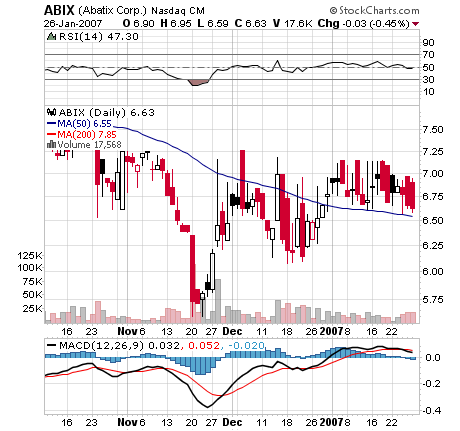
Abatix has displayed an unimpressive technical chart—until now. After hitting $15.00 per share in January 2006, Abatix hit headwinds, trading in a downtrend channel ever since, but the stock has finally landed on solid ground these last three months, consolidating in the $6.00 –to- $7.00 support level—and possibly exhibiting a classic Inverse Head And Shoulders pattern.


In our view, there is no need to rush out to buy Abatix shares. Still we will be watching, looking for signs of a break out—and close—above the $7.00 neckline resistance point (on higher than average volume of 16,542 shares per day).

The catalyst for a sustainable upward move in share price will be renewed investor confidence that Abatix has finally turned the corner, and is seeing greater traction in all business segments.

From the King James Version of the Bible, Revelation chapter 6, verse one: “And I saw when the Lamb opened one of the seals, and I heard, as it were the noise of thunder, one of the four beasts saying, Come and see.” [Ed. note. Reference to The Four Horsemen of the Apocalypse: War, Famine, Pestilence, and Death.]

June is six months away, but adverse weather events could be the calculi that produce impressive trading gains in Abatix’s share price: The National Oceanic and Atmospheric Administration (NOAA) has already issued 2007 hurricane advisories, predicting that that there could be between thirteen and sixteen named storms. Of those storms, between 8 and 10 would reach hurricane strength and four to six would go on to become major hurricanes.

Spokesmen at the NOAA have said: “Be informed and be prepared.”

We believe that investors ought to heed similar advice.

Wednesday, January 24, 2007

Universal Technical Institute -- Failing Grade


In December 2006, Universal Technical Institute Inc. (UTI-$22.32), provider of post-secondary education for students seeking careers as professional automotive, diesel, collision repair, motorcycle and marine technicians, said its fiscal 2006 income from operations fell by about 27.1%—to $40.7 million—on a sharp increase in costs and expenses.

Management had previously believed the road to sequentially higher profits was—to paraphrase from the movie
Field of Dreams: “If you build it, [they] will come.”

At a
Bank of America 35th Annual Investment Conference in September 2005, management declared that a sound growth strategy was predicated on a customer-centric, “recruit to demand” approach. They predicted that the technical markets UTI serviced would produce NEW job openings of about 51,000 per annum, with aggregate market growth of 12% -to- 19% by 2012.

How best to meet this anticipated growth? New opportunities = NEW campuses + existing campus & industry driven curriculum expansions.

Seating capacity utilization for the fiscal year ended September 30, 2006 was 64.9% as compared to 69.9% during the same period a year ago.

“Numerous external and internal factors led to lower capacity utilization,” said UTI’s management. OOPS! Seating capacity build-out grew faster than student enrollment.

Operating margin for the year ended September 30, 2006 was 13.1% down from 18.0 percent. Lower than planned students, as well as higher operating costs including compensation related costs, advertising, depreciation and a reduction in force, lowered margins as compared with the year ended September 30, 2005.

Recognizing the need to cut costs [w/o admitting errors in their business model], management in September 2006
announced a headcount reduction in its workforce:


  • "These actions, while extremely difficult, are essential to UTI improving operational effectiveness and efficiencies. Numerous external and internal factors have led to lower capacity utilization resulting in the need to reduce our operating costs. This workforce reduction is one component of a broader corporate effort to create a more efficient organizational structure. When Company-wide initiatives focused on improving capacity utilization are fully realized, the Company can build on a more efficient operating structure," commented Kimberly McWaters, President and Chief Executive Officer.

One hundred dollars invested in UTI Common Stock on December 17, 2003, was worth $67.90 as of September 30, 2006. In comparison, $100 invested in the NYSE index earned a cumulative total return worth $136.90 in the same period.

In view of the Company’s inability to execute on its business plan—student enrollment issues—the 10Q Detective believes that UTI deserves a failing grade.

One passage in the Company’s vision statement reads: “We make decisions based on the organization’s purpose, the legitimate needs of our people, and the necessity of profit.”

Has UTI demonstrated integrity in all interactions—including governance—while earning the trust and respect of others?

John C. White has served as UTI’s Chairman of the Board since October 1, 2005. The Board saw fit to pay Messer. White almost $470,000 in salary and cash bonus last year, healthcare and other “fringe benefits” of $34,139, and $129,154 in restricted stock awards.

For a Company looking to reduce its operating costs, might such compensation be considered excessive? In awarding Mr. White his incentive compensation awards, the Committee
“considered Mr. White’s position within UTI and his contributions to the continuing success of the Company.”

Dubious compensation metrics—we are being rhetorical—given that the Chairman usually carries little or no real power in terms of policy or operating decision making.

If the Company gave a monkey a gavel and sat him in the Chairman’s seat at Board meetings, would the monkey have been deserving of $470,000 in salary/bonuses?

Since 1991, UTI has leased, too, some of its properties from entities controlled by John C. White or entities in which Mr. White’s family members have an interest. In FY ’06, total payments made by UTI to these entities totaled approximately $1.87 million.

Mr. White beneficially owns about 2.7 million shares, or 9.7%, of the common stock outstanding, worth an estimated $60.3 million.

Disgruntled shareholders and enrolled UTI students can learn one lesson — and an old one at that—by observing governance habits at UTI: “He who has the gold makes the rules!”

Valuation Analysis

UIT is selling for about 30.4 times September 2008 consensus EPS estimates of 74 cents, near the high end of its trailing four-year peak-trough.

In addition, competition from online and campus-based for-profit educators—e.g. Apollo Group (APOL), Career Education (CECO), and ITT Educational (ESI), coupled with industry perception problems –closer federal oversight (alleged fraudulent payment claims at some degree program schools) and complaints of non-qualified academic staffs--will probably pressure UTI’s operating and share price performance in the coming quarters.

Editor David J Phillips does not hold financial interests in any of the companies mentioned in this posting. The 10Q Detective has a Full Disclosure policy.

Friday, January 19, 2007

Energy Profits: Advantage Energy Income & Bronco Drilling


Light Sweet Crude for February delivery dropped about 3.4%, or $1.76 a barrel, on Thursday, sending the benchmark oil contract on the New York Mercantile Exchange to its weakest close in twenty months at $50.48/bbl, after the U.S. Energy Department reported that crude supplies jumped 6.8 million barrels to 321.5 million barrels for the week ended Jan. 12, the first increase in eight weeks..

Separately, the American Petroleum Institute said crude inventories were at 322.3 million barrels for last week, up 7.6 million.

Bloated inventories, recalcitrant OPEC members unwilling to reach an accord on production cuts, and uncertainty created by the
Canadian Government’s Tax Fairness Plan—all these factors continue to weigh on North American energy shares.

In our view, oil holding the $50 floor is no longer relevant, for the recent technical weakness in energy shares have opened valuation gaps that have begun to discount lower crude prices energy stocks.

Irrespective of short-term volatility in contract prices,
the cornerstone of our investment fundament remains that oil reserve depletion is a given and long term will provide the definitive catalyst to a turnaround in prices, refining margins, and oil drilling/rigging utilization.

The substructure to our argument reflects the political reality, too, that capacity gluts are still vulnerable to disruptions from material suppliers, such as Middle East, Venezuela, Russia, and the Niger Delta.

The promise of ‘maybe’ gains from over-extended tech stocks, or potential false rallies in resource stocks, we prefer to throw our lot in with the latter. Ignoring the bears, 10Q Detective recently added two new opportunistic positions to our resources weighted model-portfolio.

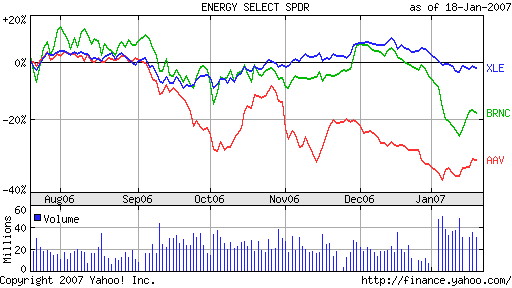
(1). Advantage Energy Income Fund (AAV-$10.90) is a Canadian oil and gas royalty trust based in Calgary, Alberta. Advantage’s oil and gas properties are spread geographically throughout the Western Canadian Sedimentary basin, with 87% of the Fund’s reserves located in Alberta, 5% in northeast Brirish Cxolumbia and 8% in southeast Saskatchewan. Advantage produces the equivalent of 30,000 barrels of oil per day: light or medium-gravity oil and natural gas account for 35%, 33% and 65%,67% of aggregate production and known reserves, respectively.

Responding to the cyclical downturn in energy prices and the uncertainty caused by the recent Canadian
government's decision to slap a new Distribution Tax on income trusts, the share price of Advantage has tumbled about 30% in the past quarter.

Typical of the “herd mentality,” from Bay Street to Wall Street, the result was a market over-reaction to the Ministry of Finance’s tax announcement. In our view, given Advantage’s trading metrics, the price looks attractive:

  • Given the current uncertainty and the need for future cap expenses, we forecast a downward adjustment of the monthly cash to $U.S. 0.12 per Unit from the recent cash distribution for the month of November of U.S. $0.16 per Unit. Nonetheless, the revised distribution represents an annualized yield of 13.2 percent.
  • The Company has a successful history of boosting reserves through (i) aggressive drilling and development of land positions adjacent to operating fields (via land sales, swaps, etc.); (ii) a three-year drilling inventory on 480,000 (net) undeveloped acres; (iii) swapping, selling, or farming out high risk exploration plays; and, (iv) acquisitions to complement and grow long life asset base (see recent Ketch Resources Trust deal). In the last five years, the reserve life index has increased from 7.2 years to approximately 11.3 years.
  • Advantage has an active go-forward hedging program in place to protect cash flow. [Summer 2007/ Natural gas & Crude Oil (WTI), $7.18/mcf – $9.26/mcf and $65.00/bbl – $90.00/bbl, respectively.]
  • Tangible book value is $8.94 per share. The trailing twelve-month leveraged free-cash flow generated was $52.3 million.

As of September 30, 2006, Advantage has an accumulated deficit of about $(387.1) million, the result of Advantage distributing three times as much in dividend distributions than accumulated income inflows. Lower oil prices and no changes in the Tax Fairness proposal might suggest that our estimated forward dividend payouts are too optimistic [albeit we see a dividend yield of at least 8% - 9% (US$) as a payout floor].

On February 6, Stephen Harper, leader of the Conservative Party was sworn in as the 22nd Prime Minister of Canada. Of investment interest, the Conservatives lead only by coalition, having won only 124 seats in the 308-member House of Commons.

In December 2005, Steven Harper issued
the following campaign promise (YouTube) when the Liberal government proposed new taxation on income trusts:

“Income trusts are popular with seniors because they provide regular payments that are used by many to cover the costs of groceries, heating bills and medicine…. The government continues to overtax Canadians and run multi-billion dollar surpluses, yet their first instinct is to attack an Investment vehicle that can make the difference between bare survival and a dignified retirement for millions of Canadians.”

Further, the Conservative federal election platform dated January 13, 2006 stated:

“A Conservative government will…Stop the Liberal attack on retirement savings and preserve income trusts by not imposing any new taxes on them.”

The Conservative government shows no sign yet of changing course, though some coalition lawmakers are having second thoughts.

However, income trusts were given a four-year tax holiday by Ottawa to make the adjustment to the new rules. And a lot can change in four years—especially if one finds their popularity poll numbers falling.

Some politicians stand firm, falling in the process—ask George Bush (no, not the 43rd President of the United States, but his dad, the 41st President).

“I'm the one who won't raise taxes. My opponent now says he'll raise them as a last resort, or a third resort. When a politician talks like that, you know that's one resort he'll be checking into. My opponent won't rule out raising taxes. But I will. The Congress will push me to raise taxes, and I'll say no, and they'll push, and I'll say no, and they'll push again, and I'll say to them,
“Read my lips: no new taxes.” – George Bush, Acceptance Speech, 1988 Republican National Convention, New Orleans, LA (play in browser (beta).

For those readers too young to remember, in the
1992 presidential election campaign, Pat Buchanan made extensive use of President Bush’s phrase in his strong challenge to Bush in the Republican primaries. In the election itself, Democratic nominee Bill Clinton running as a moderate, also pointed to the quotation as evidence of Bush's untrustworthiness, which contributed to Bush losing his bid for re-election.

CompanySymbolTrade DateQuantityPriceCost
Advantage Energy Income FundAAV01/18/2007300$10.93$3,291.93
Bronco DrillingBRNC01/16/2007300$15.01$4,515.96


(2). Contract gas driller Bronco Drilling Company (BRNC-$15.00) went public at an intial offer price of $17.00 per share on August 15, 2005. Bronco is a provider of contract land drilling services to oil and natural gas exploration and production companies. Bronco currently operates in Colorado, Oklahoma, Kansas, North Dakota, Texas, and Wyoming, with the majority of the wells drilled for its customers in search of natural gas reserves.

The Company owns a fleet of 64 land drilling rigs, with a deployment utilization rate of about 78 percent. The Company recently expanded the scope and scale of its operations with the acquisition of Eagle Well Services Company, which brings to Bronco accretive assets, including workover and well servicing rigs.

Bronco’s contract drilling revenues for nine-months ended September 30, 2006, skyrocketed to $203.3 million compared with $38.8 million for prior year. The Company generated net income of $43.5 million, or share-net of $1.77, compared with a net loss of $(1.71) million, or $(0.12) per share in 2005.

Average operating rigs in operation for the nine-months of 2006 grew to 43 from 17 for the previous year. The growth in rigs was due to the continued refurbishment and deployment of rigs from the Company's inventory. Revenue days for the year-to-date (2006) increased to 11,024 from 3,251 for the previous period. Utilization for the three quarters of 2006 remained stable at 94 percent.

In our view, Bronco is a well-managed star among small-cap oil-service companies. A market capitalization, a forward (2007) P/E multiple, and a book value per share of $382.0 million, 5.51 times, and $12.94, respectively—all these valuations position investors with a standout growth opportunity in the natural gas sector.

By comparison, key statistics for contract drilling competitors are:

  1. Nabors Industries (NBR-$29.48), market cap – $8.8 Billion; forward (2007) P/E – 6.7x; book value – $11.85.
  2. Patterson-UTI Energy (PTEN-$23.51), market cap – $3.74 Billion; forward (2007) P/E – 6.3x; book – $9.37.
  3. Helmerich & Payne (HP-$24.91), market cap. – $2.58 Billion; forward (2007) P/E – 6.3x; book – $13.30.

The Energy Information Administration (EIA) has estimated that U.S. consumption of natural gas exceeded domestic production by 21% in 2005 and forecasts that U.S. consumption of natural gas will exceed U.S. domestic production by 26% in 2010.

In addition, the National Petroleum Council has stated that average “initial production rates from new wells have been sustained through the use of advanced technology; however, production declines from these initial rates have increased significantly; and recoverable volume from new wells drilled in mature producing basins have declined over time.” The Council predicts that by 2013 about 80% of gas production “will be from wells yet to be drilled.”

The 10Q Detective believes that Bronco—through its strategic acquisitions—is well positioned to be more than just a ‘bit player’ in the contract-drilling sector. Pricing, rig availability, experience of its rig crews, and its offering of ancillary services—in terms of scope and scale, oil and natural gas exploration and production companies looking to increase drilling activity in the U.S., are finding Bronco to be a standout among the best operators.

Accelerating gas field depletion rates and healthy demand for natural gas, in our view, will continue to support activity and demand for land drilling A successful execution of Bronco’s business plan—to expand its rig fleet, geographic focus, and ancillary rigging/hauling services—by an experienced management team should result in higher rig day rates and rig utilization in the coming years.

Disciplined investors should be rewarded with attractive returns.

Editor David J Phillips holds financial interests in Bronco Drilling and several Canadian royalty income trusts, including Advantage Income Fund. The 10Q Detective has a Full Disclosure policy.